Code
curve(dchisq(x, df = 10), from = 0, to = 40, xlab="X", ylab="f(X)", main = "Chi-squared density", sub = "(df = 10)")
The random variate \(X\) defined for the range \(0 \leq X \leq +\infty\), is said to have a Chi-squared Distribution with 1 parameter (i.e. \(X \sim \chi^2 \left( n \right)\)) with shape parameter \(n \in \mathbb{N}^+\).
\[ \text{f}(X) = \frac{ X^{\frac{n}{2}-1} e^{- \frac{X}{2} } }{ 2^{\frac{n}{2}} \mathrm{ \Gamma} \left[ \frac{n}{2} \right] } \]
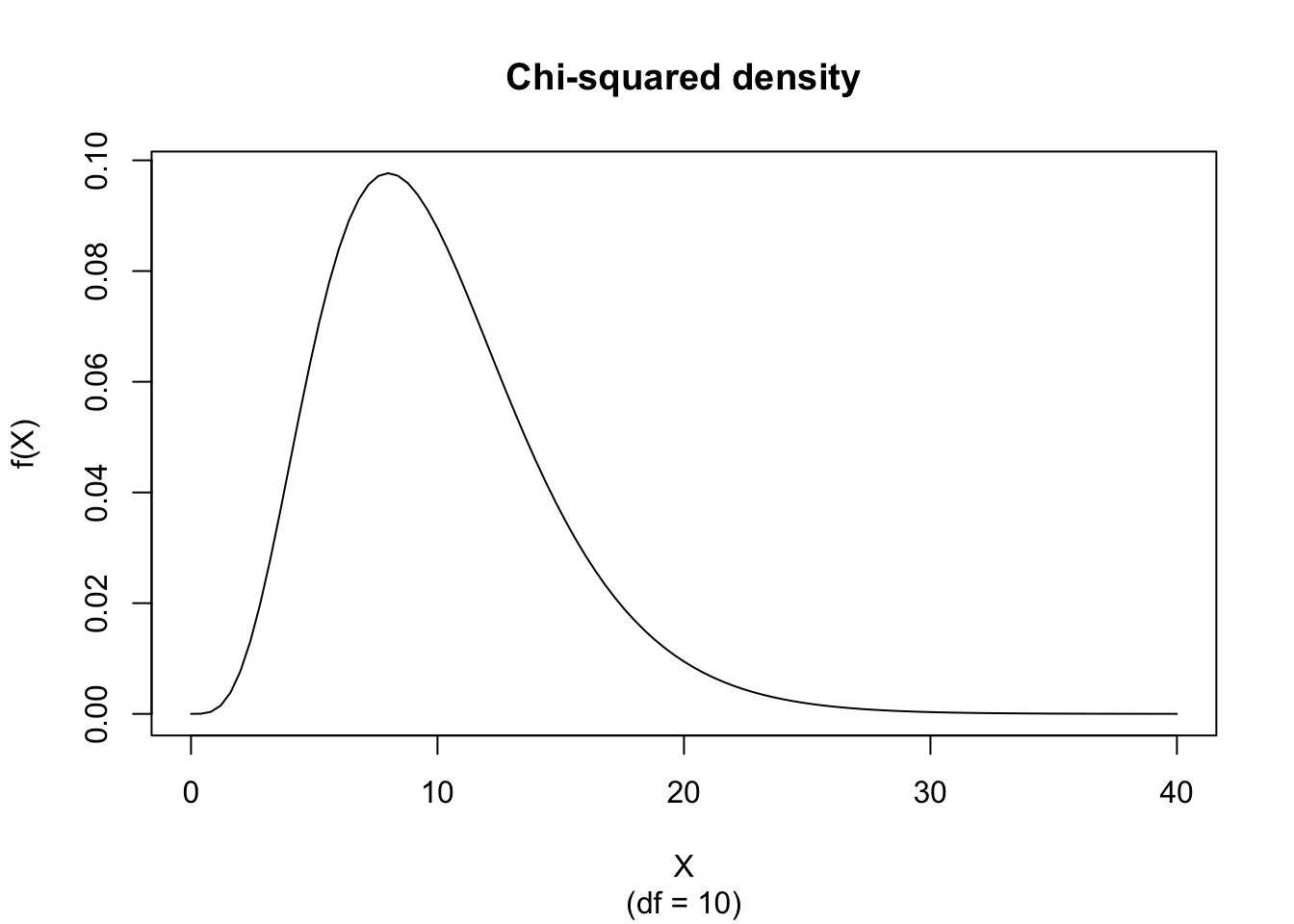
The figure below shows an example of the Chi-squared Probability Density function with \(df = 10\).
If \(n/2 \notin \mathbb{N}^+\) then there is no closed form. If \(n/2 \in \mathbb{N}^+\) then
\[ \text{F}(X) = 1 - e^{-\frac{X}{2}} \sum_{j=0}^{r-1} \frac{\left( \frac{X}{2} \right)^j}{j!} \]
where \(r = \frac{n}{2}\).
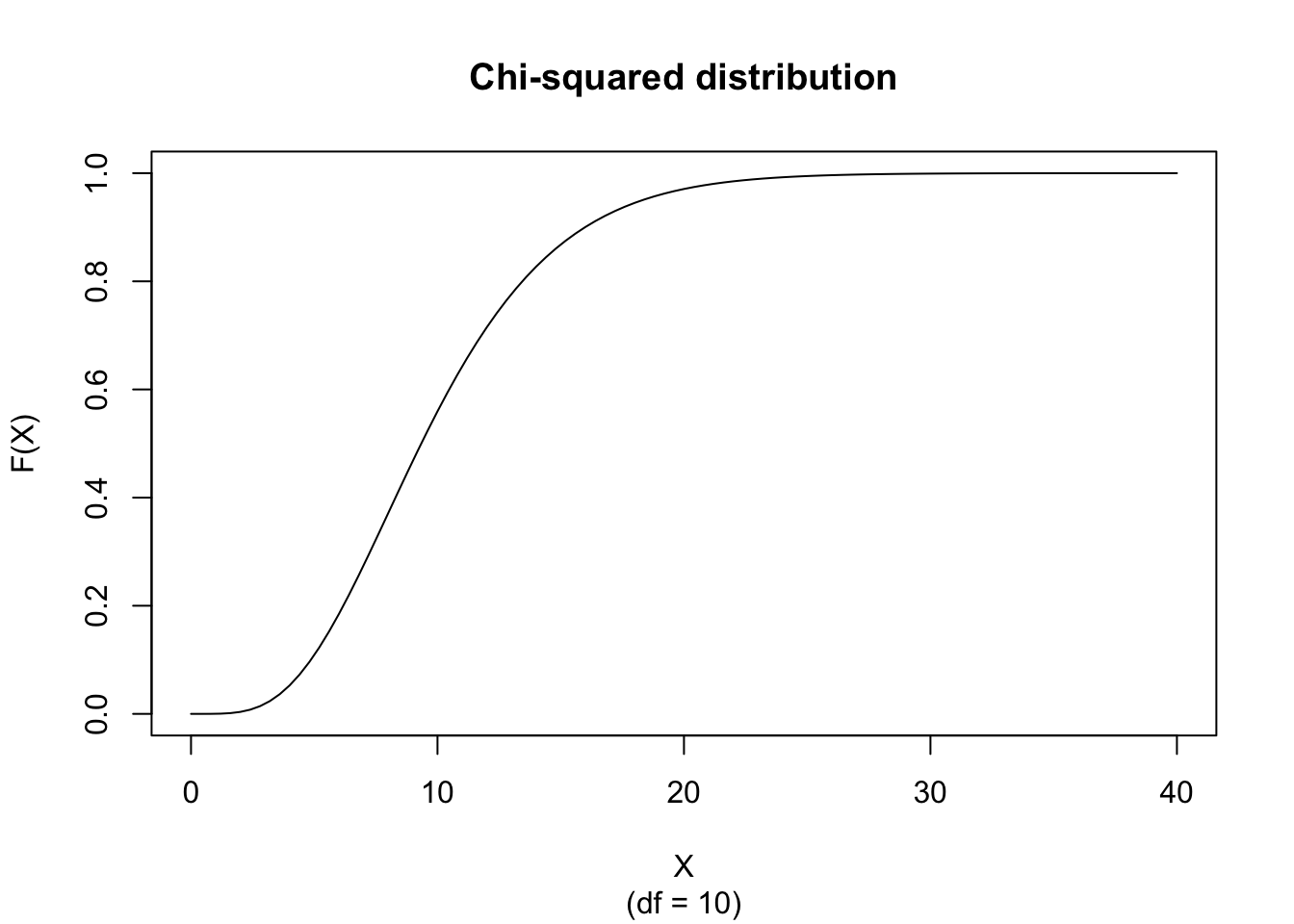
The figure below shows an example of the Chi-squared Distribution with \(df = 10\).
\[ \text{M}_X(t) = (1-2t)^{-\frac{n}{2}} \]
for \(t < \frac{1}{2}\).
\[ \mu_j' = 2^j \frac{\mathrm{\Gamma}\left[ \frac{n}{2}+j \right]}{\mathrm{\Gamma}\left[ \frac{n}{2} \right]} \]
\[ \text{E}(X) = n \]
\[ \text{V}(X) = 2n \]
\[ \text{Mo}(X) = n - 2 \]
for \(n \geq 2\).
\[ g_1 = 2 \sqrt{\frac{2}{n}} \]
\[ g_2 = 3 + \frac{12}{n} \]
\[ VC = \sqrt{\frac{2}{n}} \]
The best fitting Chi-squared Density function can be obtained by estimating the degrees of freedom \(n\) according to the so-called Maximum Likelihood procedure which can be found on the public website:
The Maximum Likelihood Fitting for the Chi-squared Distribution is also available in RFC under the menu “Distributions / ML Fitting” (you have to select the appropriate function in the designated “Density Function” drop menu).
If you prefer to compute the Chi-squared ML fitting on your local computer, the following code snippets can be used in the R console:
estimated df = 256.2321
standard deviation = 1.882792
and
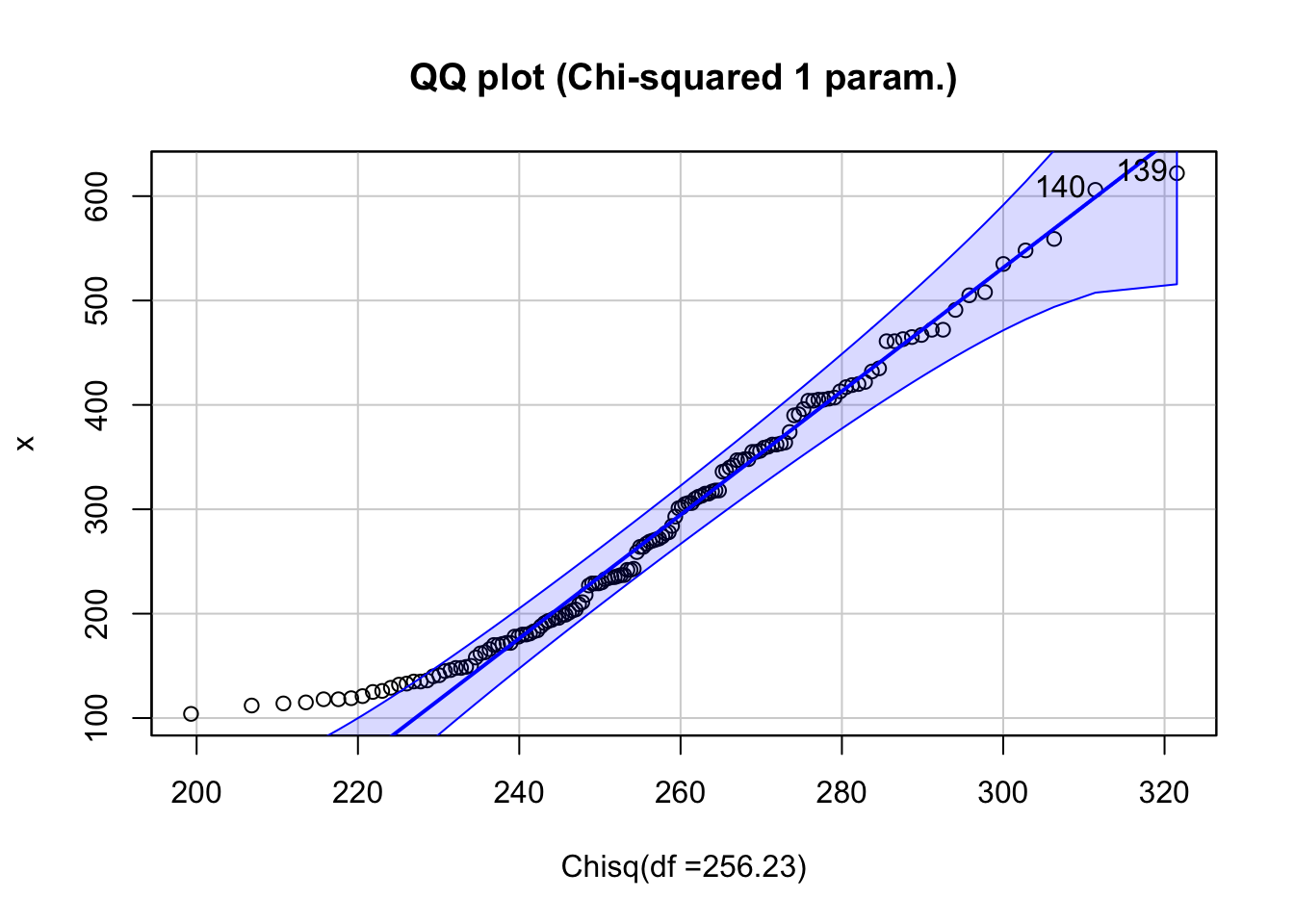
[1] 139 140
The main function in this R script is fitdistr and is limited by the user-specified lower and upper limit. Instead of displaying a histogram, the script calls the qqPlot function from the car library. The interpretation of this plot is explained in Descriptive Statistics.
We analyze the time series of monthly divorces (in thousands) and wish to find out whether it can be adequately described by the Chi-squared Distribution. The ML Fitting module can be used to find the best fitting Chi-squared Distribution for the divorces data.
The estimated degrees of freedom is \(n = 3.46\) but the Chi-squared distribution does not fit the data well (as is shown in the Figure). The visual evidence suggests that a Chi-squared density is not appropriate for these data; for formal goodness-of-fit testing, see Section 2, Section 124.1, and Chapter 125.
If the following is true
\[ \begin{align*} \begin{cases} \text{U}(0,1) \text{ denotes a Uniform Distribution} \\ \text{N}(0,1) \text{ denotes a Standard Normal Distribution} \end{cases} \end{align*} \]
then \(\chi^2(n) \sim -2 \text{ln} \left( \prod_{i=1}^{r} \text{U}_i(0,1) \right)\) with \(r=\frac{n}{2}\) and \(n\) is even
and \(\chi^2(n) \sim -2 \ln \left( \prod_{i=1}^{r} \text{U}_i(0,1) \right) + \left( \text{N}\left( 0, 1 \right) \right)^2\) with \(r=\frac{n-1}{2}\) and \(n\) is odd
The Chi-squared Distribution with one parameter \(n\) is a particular form of the Gamma Distribution. Defined in its general form, the probability density function of the three parameter Gamma Distribution is
\[ \text{f}(Y) = \frac{(Y-c)^{a-1} e^{-\frac{Y-c}{b}}}{\mathrm{\Gamma}[a]b^a} \]
where \(c \leq Y \leq +\infty\), \(0 < a\), \(0 < b\), and \(-\infty \leq c \leq +\infty\).
If the shape parameter \(a = \frac{n}{2}\), the scale parameter \(b = 2\), and the location parameter \(c = 0\), then this three parameter Gamma Distribution is called a Chi-squared Distribution with parameter (degrees of freedom) equal to \(n\).
The Chi-squared variate with \(n\) degrees of freedom, is equal to the three parameter Gamma variate with location parameter zero, scale parameter 2, and shape parameter \(n/2\), or equivalently, is twice the Gamma variate with location parameter zero, scale parameter one, and shape parameter \(n/2\).
The Chi-squared variate with \(n\) degrees of freedom, is equal to the sum of squares of \(n\) independent variates with Standard Normal Distribution, i.e.
\[ \chi^2(n) \sim \sum_{i=1}^{n} Y_i^2 \]
where \(Y_i = \text{N}(0,1)\).
The Chi-squared variate with degrees of freedom \(n\) (for \(n > 30\)) is approximately equal to half the square of a normal variate with expected value equal to the square root of \((2n-1)\) and unit variance, i.e.
\[ \chi^2(n) \sim \frac{1}{2} Y^2 \]
where \(Y \sim \text{N}(\mu,1)\) with \(\mu = \sqrt{2n-1}\).
Given \(n\) independent normal variates with expected value \(\mu\) and variance \(\sigma^2\), the sum of squared deviations from the population mean \(\mu\) is distributed as \(\sigma^2\) times a Chi-squared variate with \(n\) degrees of freedom, i.e.
\[ \frac{ns^2}{\sigma^2} \sim \chi^2(n) \]
or
\[ ns^2 = \sum_{i=1}^{n} \left( x_i - \mu \right)^2 \sim \sigma^2 \chi^2(n) \]
where
\[ s^2 = \frac{1}{n} \sum_{i=1}^{n} \left( x_i - \mu \right)^2 \]
and
\[ X_i \sim \text{N} \left( \mu, \sigma^2 \right) \]
Given \(n\) independent normal variates with expected value \(\mu\) and variance \(\sigma^2\), the sum of squared deviations from the sample mean \(\bar{x}\) is distributed as \(\sigma^2\) times a Chi-squared variate with \(n-1\) degrees of freedom, i.e.
\[ \frac{(n-1)s^2}{\sigma^2} \sim \chi^2(n-1) \]
or
\[ (n-1)s^2 = \sum_{i=1}^{n} \left( x_i - \bar{x} \right)^2 \sim \sigma^2 \chi^2(n-1) \]
where
\[ s^2 = \frac{1}{n-1} \sum_{i=1}^{n} \left( x_i - \bar{x} \right)^2 \]
and
\[ \bar{x} = \frac{1}{n} \sum_{i=1}^{n} x_i \]
and
\[ X_i \sim \text{N} \left( \mu, \sigma^2 \right) \]
If
\[ \frac{n_1 s_1^2}{\sigma^2} \sim \chi^2 \left( n_1 - 1 \right) \]
\[ \frac{n_2 s_2^2}{\sigma^2} \sim \chi^2 \left( n_2 - 1 \right) \]
then
\[ \frac{n_1 s_1^2 + n_2 s_2^2}{\sigma^2} \sim \chi^2 \left( n_1 + n_2 - 2 \right) \]
where \(s_i^2\) is a biased estimate of \(\sigma^2\), defined as
\[ s_i^2 = \frac{1}{n_i} \sum_{j=1}^{n_i} \left( x_{ij} - \bar{x}_i \right)^2 \]
with
\[ \bar{x}_i = \frac{1}{n_i} \sum_{j=1}^{n_i} x_{ij} \]
and where the observations of sample \(i\) are drawn from a normal population with expected value \(\mu_i\) and variance \(\sigma^2\).
The Chi-squared variate with \(m\) degrees of freedom, denoted by \(\chi^2(m)\), and the Chi-squared variate with \(n\) degrees of freedom, denoted by \(\chi^2(n)\), are related to the F variate with degrees of freedom \(m\) and \(n\), denoted F\((m,n)\) through the following relationship
\[ \text{F}(m,n) \sim \frac{\frac{\chi^2(m)}{m}}{\frac{\chi^2(n)}{n}} \]
where both Chi-squared variates are independent.
The Chi-squared variate with \(m\) degrees of freedom is equal to \(m\) times the F variate with degrees of freedom \(m\) and \(\infty\), i.e.
\[ \chi^2(m) \sim m \text{F}(m,\infty) \]
The Chi-squared variate with \(n\) degrees of freedom, denoted by \(\chi^2(n)\), is related to the Student’s t variate with \(n\) degrees of freedom, denoted t\((n)\), and the Standard Normal variate N\((0,1)\) through the following relationship
\[ \chi^2(n) \sim n \frac{\left[\text{N}(0,1)\right]^2}{\left[\text{t}(n)\right]^2} \]
The Chi-squared variate \(\chi^2(n)\) can be seen as a special case of the two parameter Chi-squared Distribution \(\chi^2\left( n, \sigma \right)\) with \(\sigma = 1\).
For an even number of degrees of freedom, \(n = 2r\) with \(r \in \mathbb{N}^+\), the Chi-squared variate \(\chi^2(n)\) is related to the Poisson variate with parameter and expected value equal to \(\frac{X}{2}\), denoted by Poi\(\left( \frac{X}{2} \right)\), through
\[ \text{P} \left( \chi^2(2r) \geq X \right) = \text{P} \left( \text{Poi} \left( \frac{X}{2} \right) \leq r - 1 \right) \]
For odd degrees of freedom, compute the tail probability with pchisq() (or the incomplete-gamma form).
If \(X\) and \(Y\) are both, independently, Chi-squared variates, each with two degrees of freedom then the variate \(Z = \frac{1}{2} (X - Y)\) follows a double Exponential Distribution, also known as the Laplace Distribution.