• Descriptive
    • Moments
    • Concentration
    • Central Tendency
    • Variability
    • Stem-and-Leaf Plot
    • Histogram & Frequency Table
    • Data Quality Forensics
    • Conditional EDA
    • Quantiles
    • Kernel Density Estimation
    • Normal QQ Plot
    • Bootstrap Plot

    • Multivariate Descriptive Statistics
  • Distributions
    • Binomial Probabilities
    • Geometric Probabilities
    • Negative Binomial Probabilities
    • Hypergeometric Probabilities
    • Multinomial Probabilities
    • Dirichlet
    • Poisson Probabilities

    • Exponential
    • Gamma
    • Erlang
    • Weibull
    • Rayleigh
    • Maxwell-Boltzmann
    • Lognormal
    • Pareto
    • Inverse Gamma
    • Inverse Chi-Square

    • Beta
    • Power
    • Beta Prime (Inv. Beta)
    • Triangular

    • Normal (area)
    • Logistic
    • Laplace
    • Cauchy (standard)
    • Cauchy (location-scale)
    • Gumbel
    • Fréchet
    • Generalized Extreme Value

    • Normal RNG
    • ML Fitting
    • Tukey Lambda PPCC
    • Box-Cox Normality Plot
    • Noncentral t
    • Noncentral F
    • Sample Correlation r

    • Empirical Tests
  • Hypotheses
    • Theoretical Aspects of Hypothesis Testing
    • Bayesian Inference
    • Minimum Sample Size

    • Empirical Tests
    • Multivariate (pair-wise) Testing
  • Models
    • Manual Model Building
    • Guided Model Building
  • Time Series
    • Time Series Plot
    • Decomposition
    • Exponential Smoothing

    • Blocked Bootstrap Plot
    • Mean Plot
    • (P)ACF
    • VRM
    • Standard Deviation-Mean Plot
    • Spectral Analysis
    • ARIMA

    • Cross Correlation Function
    • Granger Causality
  1. Descriptive Statistics & Exploratory Data Analysis
  2. 88  Mean Plot
  • Preface
  • Getting Started
    • 1  Introduction
    • 2  Why Do We Need Innovative Technology?
    • 3  Basic Definitions
    • 4  The Big Picture: Why We Analyze Data
  • Introduction to Probability
    • 5  Definitions of Probability
    • 6  Jeffreys’ axiom system
    • 7  Bayes’ Theorem
    • 8  Sensitivity and Specificity
    • 9  Naive Bayes Classifier
    • 10  Law of Large Numbers

    • 11  Problems
  • Probability Distributions
    • 12  Bernoulli Distribution
    • 13  Binomial Distribution
    • 14  Geometric Distribution
    • 15  Negative Binomial Distribution
    • 16  Hypergeometric Distribution
    • 17  Multinomial Distribution
    • 18  Poisson Distribution

    • 19  Uniform Distribution (Rectangular Distribution)
    • 20  Normal Distribution (Gaussian Distribution)
    • 21  Gaussian Naive Bayes Classifier
    • 22  Chi Distribution
    • 23  Chi-squared Distribution (1 parameter)
    • 24  Chi-squared Distribution (2 parameters)
    • 25  Student t-Distribution
    • 26  Fisher F-Distribution
    • 27  Exponential Distribution
    • 28  Lognormal Distribution
    • 29  Gamma Distribution
    • 30  Beta Distribution
    • 31  Weibull Distribution
    • 32  Pareto Distribution
    • 33  Inverse Gamma Distribution
    • 34  Rayleigh Distribution
    • 35  Erlang Distribution
    • 36  Logistic Distribution
    • 37  Laplace Distribution
    • 38  Gumbel Distribution
    • 39  Cauchy Distribution
    • 40  Triangular Distribution
    • 41  Power Distribution
    • 42  Beta Prime Distribution
    • 43  Sample Correlation Distribution
    • 44  Dirichlet Distribution
    • 45  Generalized Extreme Value (GEV) Distribution
    • 46  Frechet Distribution
    • 47  Noncentral t Distribution
    • 48  Noncentral F Distribution
    • 49  Inverse Chi-Squared Distribution
    • 50  Maxwell-Boltzmann Distribution
    • 51  Distribution Relationship Map

    • 52  Problems
  • Descriptive Statistics & Exploratory Data Analysis
    • 53  Types of Data
    • 54  Datasheets

    • 55  Frequency Plot (Bar Plot)
    • 56  Frequency Table
    • 57  Contingency Table
    • 58  Binomial Classification Metrics
    • 59  Confusion Matrix
    • 60  ROC Analysis

    • 61  Stem-and-Leaf Plot
    • 62  Histogram
    • 63  Data Quality Forensics
    • 64  Quantiles
    • 65  Central Tendency
    • 66  Variability
    • 67  Skewness & Kurtosis
    • 68  Concentration
    • 69  Notched Boxplot
    • 70  Scatterplot
    • 71  Pearson Correlation
    • 72  Rank Correlation
    • 73  Partial Pearson Correlation
    • 74  Simple Linear Regression
    • 75  Moments
    • 76  Quantile-Quantile Plot (QQ Plot)
    • 77  Normal Probability Plot
    • 78  Probability Plot Correlation Coefficient Plot (PPCC Plot)
    • 79  Box-Cox Normality Plot
    • 80  Kernel Density Estimation
    • 81  Bivariate Kernel Density Plot
    • 82  Conditional EDA: Panel Diagnostics
    • 83  Bootstrap Plot (Central Tendency)
    • 84  Survey Scores Rank Order Comparison
    • 85  Cronbach Alpha

    • 86  Equi-distant Time Series
    • 87  Time Series Plot (Run Sequence Plot)
    • 88  Mean Plot
    • 89  Blocked Bootstrap Plot (Central Tendency)
    • 90  Standard Deviation-Mean Plot
    • 91  Variance Reduction Matrix
    • 92  (Partial) Autocorrelation Function
    • 93  Periodogram & Cumulative Periodogram

    • 94  Problems
  • Hypothesis Testing
    • 95  Normal Distributions revisited
    • 96  The Population
    • 97  The Sample
    • 98  The One-Sided Hypothesis Test
    • 99  The Two-Sided Hypothesis Test
    • 100  When to use a one-sided or two-sided test?
    • 101  What if \(\sigma\) is unknown?
    • 102  The Central Limit Theorem (revisited)
    • 103  Statistical Test of the Population Mean with known Variance
    • 104  Statistical Test of the Population Mean with unknown Variance
    • 105  Statistical Test of the Variance
    • 106  Statistical Test of the Population Proportion
    • 107  Statistical Test of the Standard Deviation \(\sigma\)
    • 108  Statistical Test of the difference between Means -- Independent/Unpaired Samples
    • 109  Statistical Test of the difference between Means -- Dependent/Paired Samples
    • 110  Statistical Test of the difference between Variances -- Independent/Unpaired Samples

    • 111  Hypothesis Testing for Research Purposes
    • 112  Decision Thresholds, Alpha, and Confidence Levels
    • 113  Bayesian Inference for Decision-Making
    • 114  One Sample t-Test
    • 115  Skewness & Kurtosis Tests
    • 116  Paired Two Sample t-Test
    • 117  Wilcoxon Signed-Rank Test
    • 118  Unpaired Two Sample t-Test
    • 119  Unpaired Two Sample Welch Test
    • 120  Two One-Sided Tests (TOST) for Equivalence
    • 121  Mann-Whitney U test (Wilcoxon Rank-Sum Test)
    • 122  Bayesian Two Sample Test
    • 123  Median Test based on Notched Boxplots
    • 124  Chi-Squared Tests for Count Data
    • 125  Kolmogorov-Smirnov Test
    • 126  One Way Analysis of Variance (1-way ANOVA)
    • 127  Kruskal-Wallis Test
    • 128  Two Way Analysis of Variance (2-way ANOVA)
    • 129  Repeated Measures ANOVA
    • 130  Friedman Test
    • 131  Testing Correlations
    • 132  A Note on Causality

    • 133  Problems
  • Regression Models
    • 134  Simple Linear Regression Model (SLRM)
    • 135  Multiple Linear Regression Model (MLRM)
    • 136  Logistic Regression
    • 137  Generalized Linear Models
    • 138  Multinomial and Ordinal Logistic Regression
    • 139  Cox Proportional Hazards Regression
    • 140  Conditional Inference Trees
    • 141  Leaf Diagnostics for Conditional Inference Trees
    • 142  Conditional Random Forests
    • 143  Hypothesis Testing with Linear Regression Models (from a Practical Point of View)

    • 144  Problems
  • Introduction to Time Series Analysis
    • 145  Case: the Market of Health and Personal Care Products
    • 146  Decomposition of Time Series
    • 147  Ad hoc Forecasting of Time Series
  • Box-Jenkins Analysis
    • 148  Introduction to Box-Jenkins Analysis
    • 149  Theoretical Concepts
    • 150  Stationarity
    • 151  Identifying ARMA parameters
    • 152  Estimating ARMA Parameters and Residual Diagnostics
    • 153  Forecasting with ARIMA models
    • 154  Intervention Analysis
    • 155  Cross-Correlation Function
    • 156  Transfer Function Noise Models
    • 157  General-to-Specific Modeling
  • Model Building Strategies
    • 158  Introduction to Model Building Strategies
    • 159  Manual Model Building
    • 160  Model Validation
    • 161  Regularization Methods
    • 162  Hyperparameter Optimization Strategies
    • 163  Guided Model Building in Practice
    • 164  Diagnostics, Revision, and Guided Forecasting
    • 165  Leakage, Target Encoding, and Robust Regression
  • References
  • Appendices
    • Appendices
    • A  Method Selection Guide
    • B  Presentations and Teaching Materials
    • C  R Language Concepts for Statistical Computing
    • D  Matrix Algebra
    • E  Standard Normal Table (Gaussian Table)
    • F  Critical values of Student’s \(t\) distribution with \(\nu\) degrees of freedom
    • G  Upper-tail critical values of the \(\chi^2\)-distribution with \(\nu\) degrees of freedom
    • H  Lower-tail critical values of the \(\chi^2\)-distribution with \(\nu\) degrees of freedom

Table of contents

  • 88.1 Definition
    • 88.1.1 Horizontal axis
    • 88.1.2 Vertical axis
  • 88.2 R Module
    • 88.2.1 Public website
    • 88.2.2 RFC
  • 88.3 Purpose
  • 88.4 Pros & Cons
    • 88.4.1 Pros
    • 88.4.2 Cons
  • 88.5 Example
  • 88.6 Task
  1. Descriptive Statistics & Exploratory Data Analysis
  2. 88  Mean Plot

88  Mean Plot

88.1 Definition

The Mean Plot visualizes the Arithmetic Mean for sequential and periodic subseries (groups of data). The Mean Plot analysis consists of 6 charts:

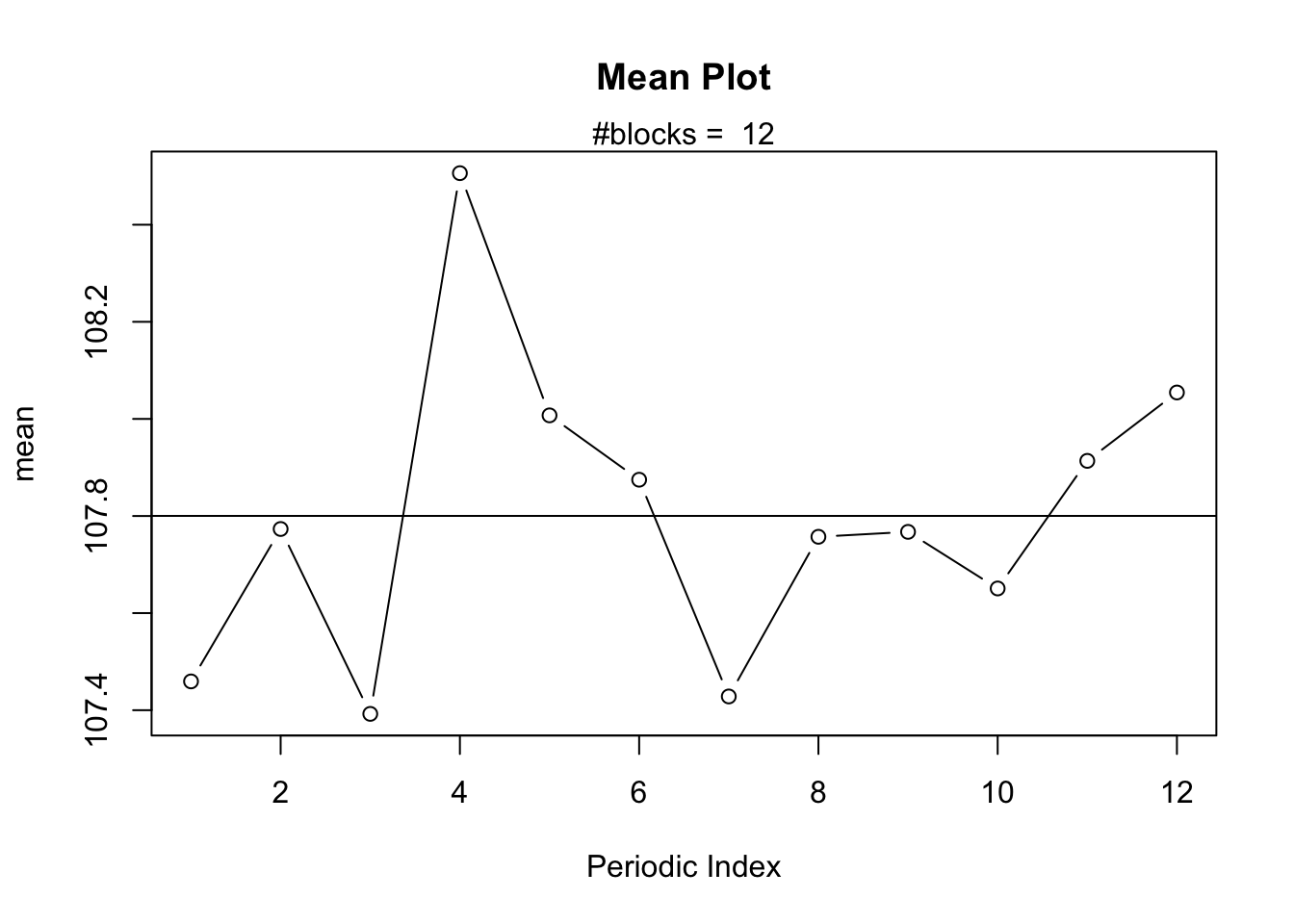
  • The actual Mean Plot which displays the Arithmetic Mean against the Periodic Index for a pre-specified blockwidth parameter.
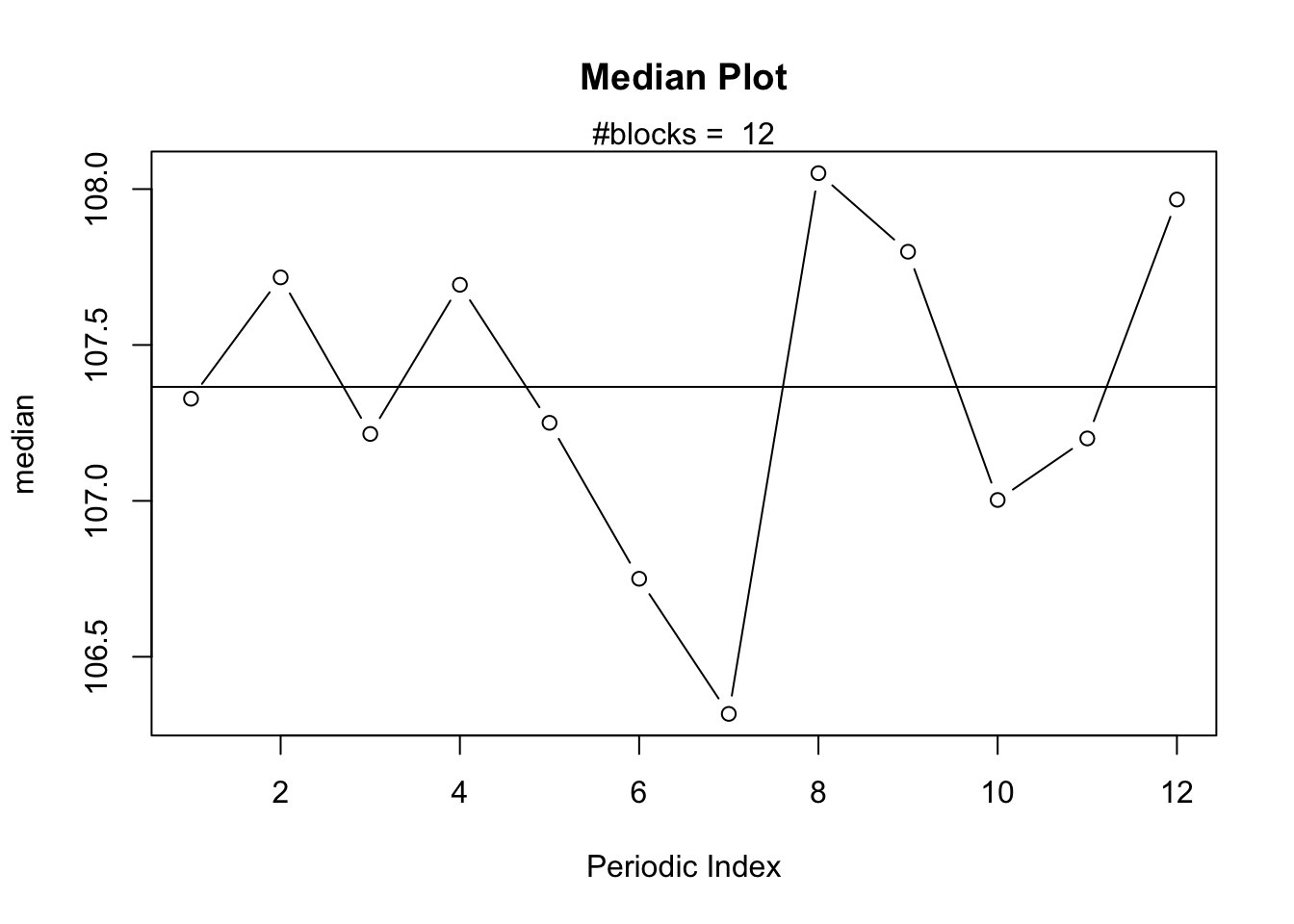
  • The Median Plot which displays the Median against the Periodic Index.
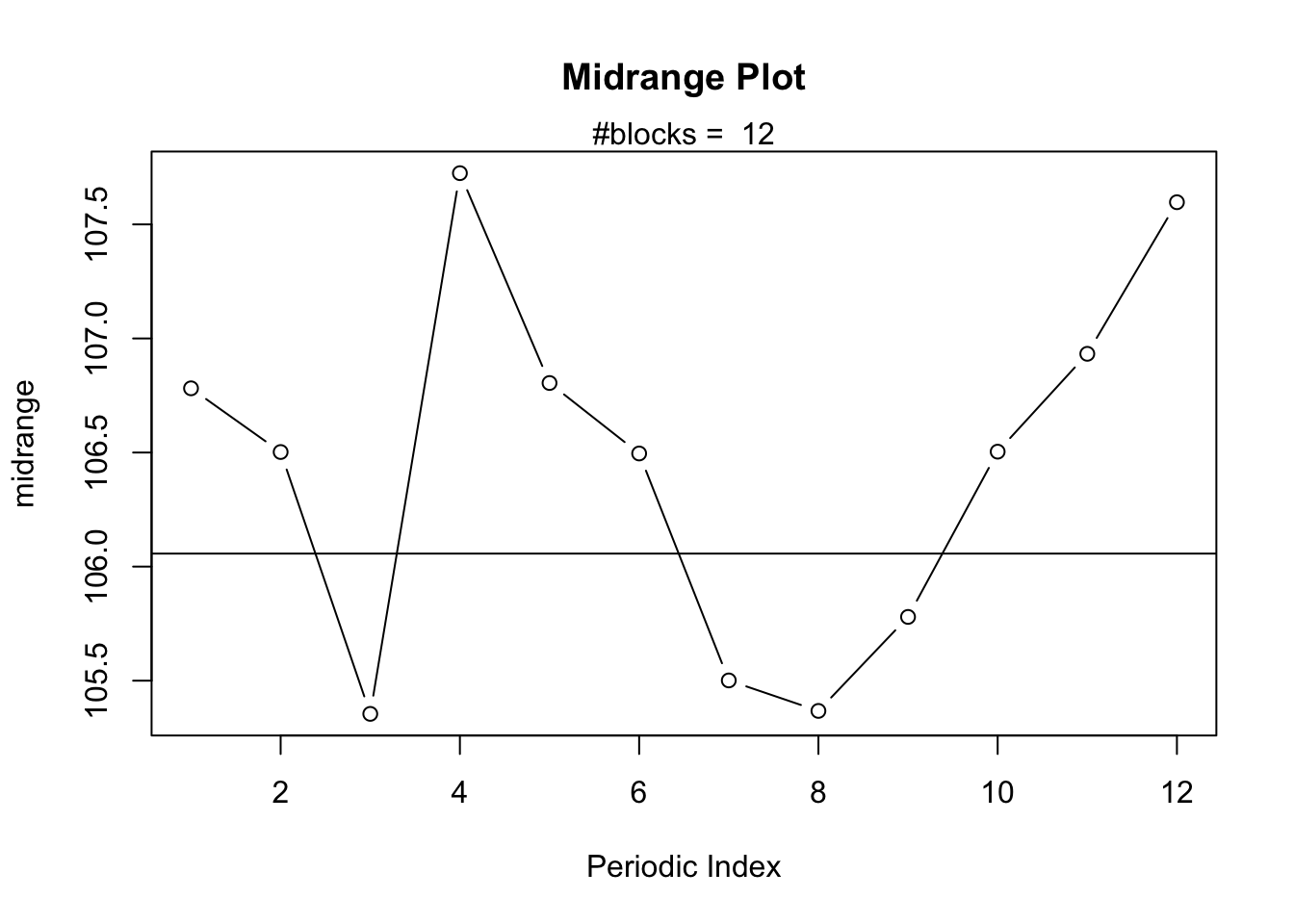
  • The Midrange Plot which displays the Midrange against the Periodic Index.
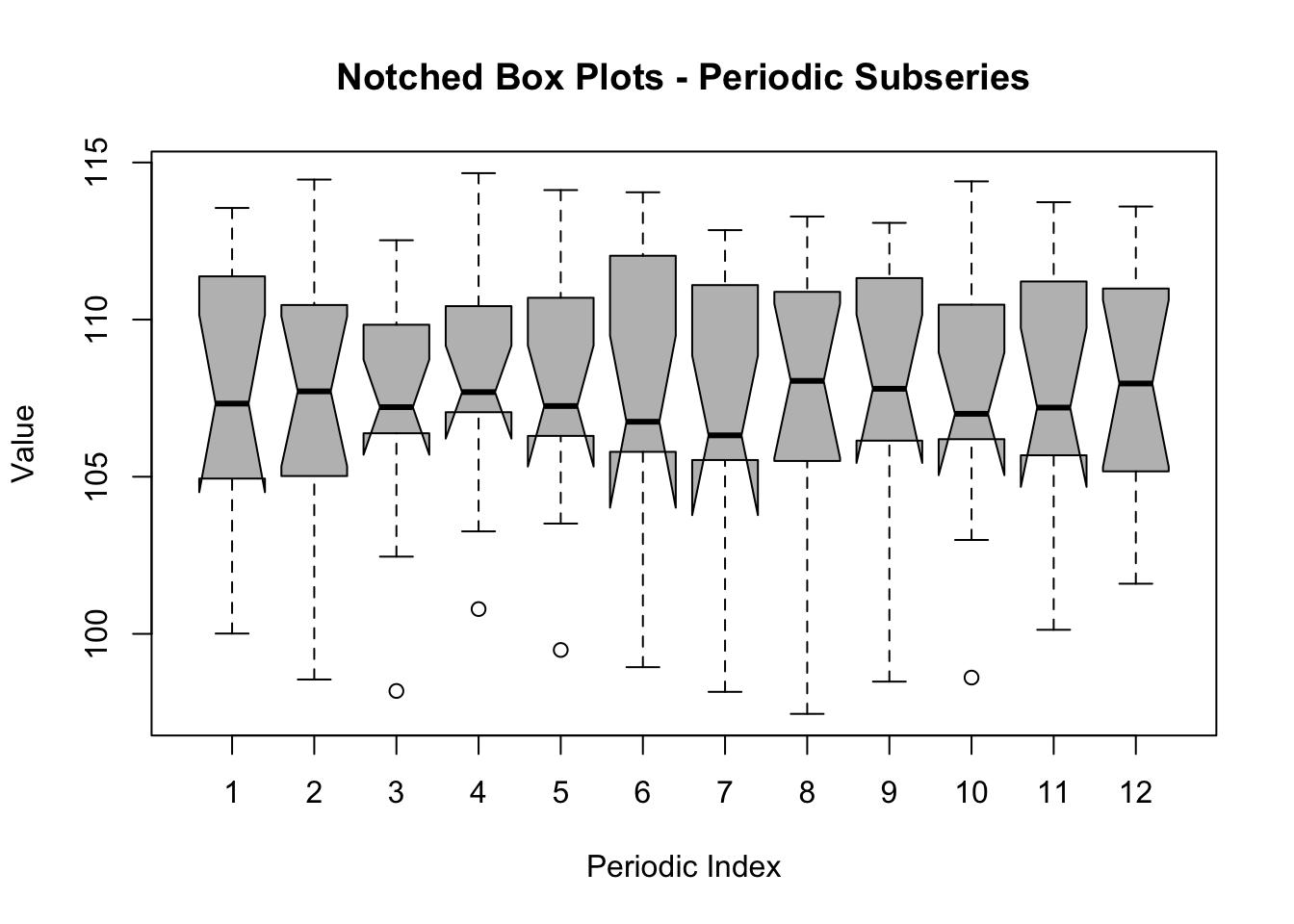
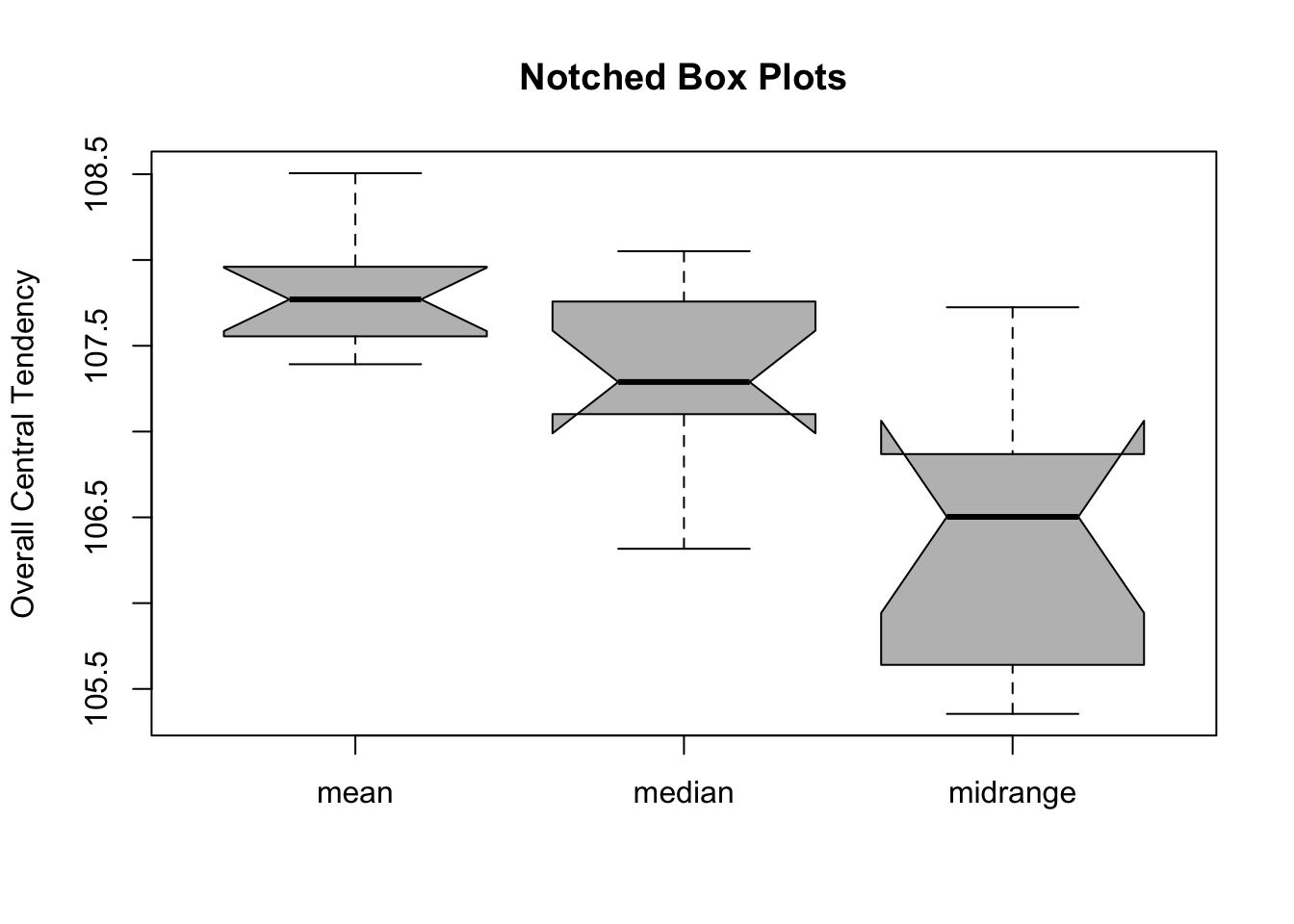
  • The Notched Boxplots for periodic subseries shows the same information as the Median Plot but with added Boxplots.
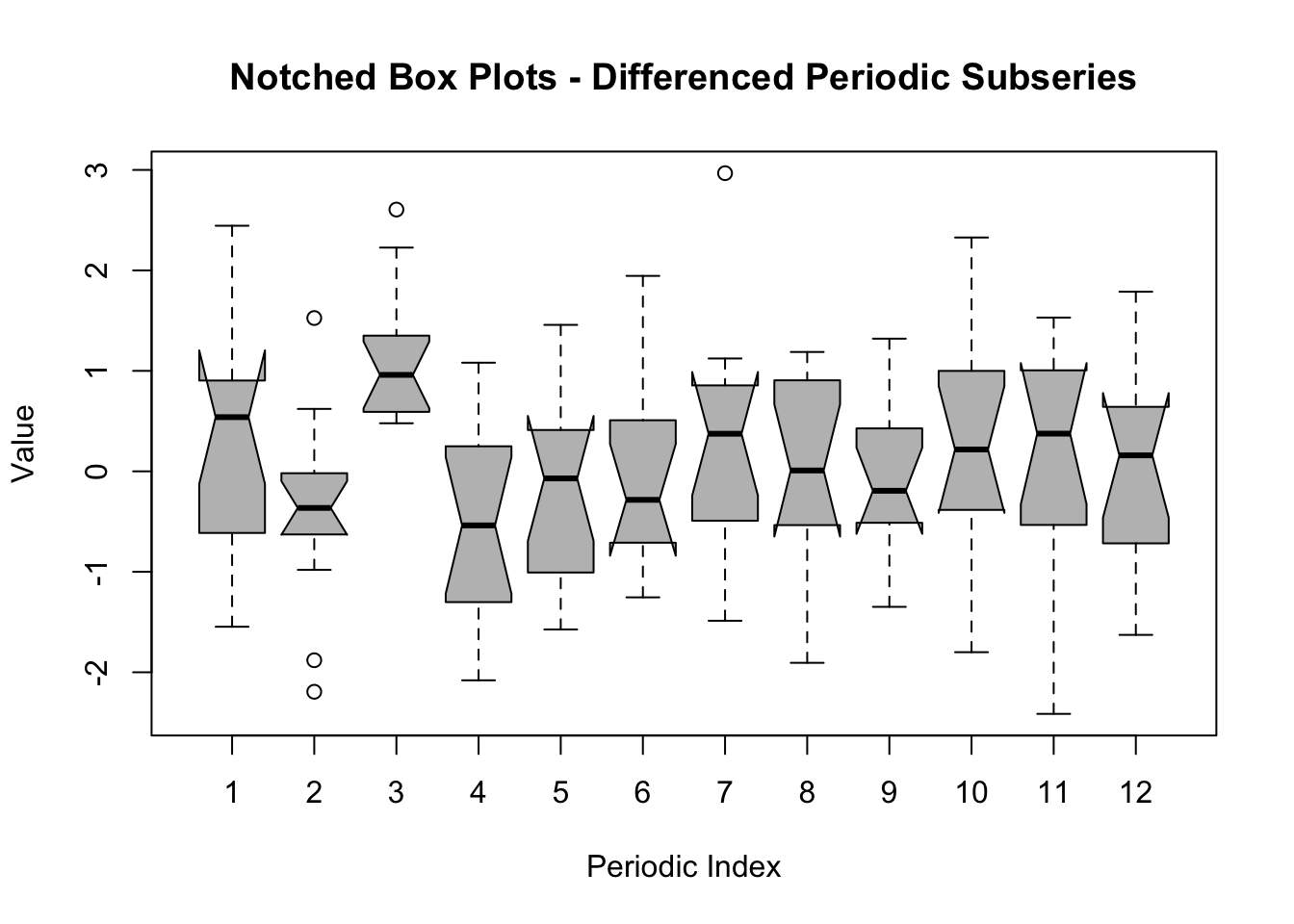
  • The Notched Boxplots for differenced periodic subseries is the same as the previous plot but the data have been transformed first: instead of using the original time series \(Y_t\) we use \(Y_t - Y_{t-1}\).
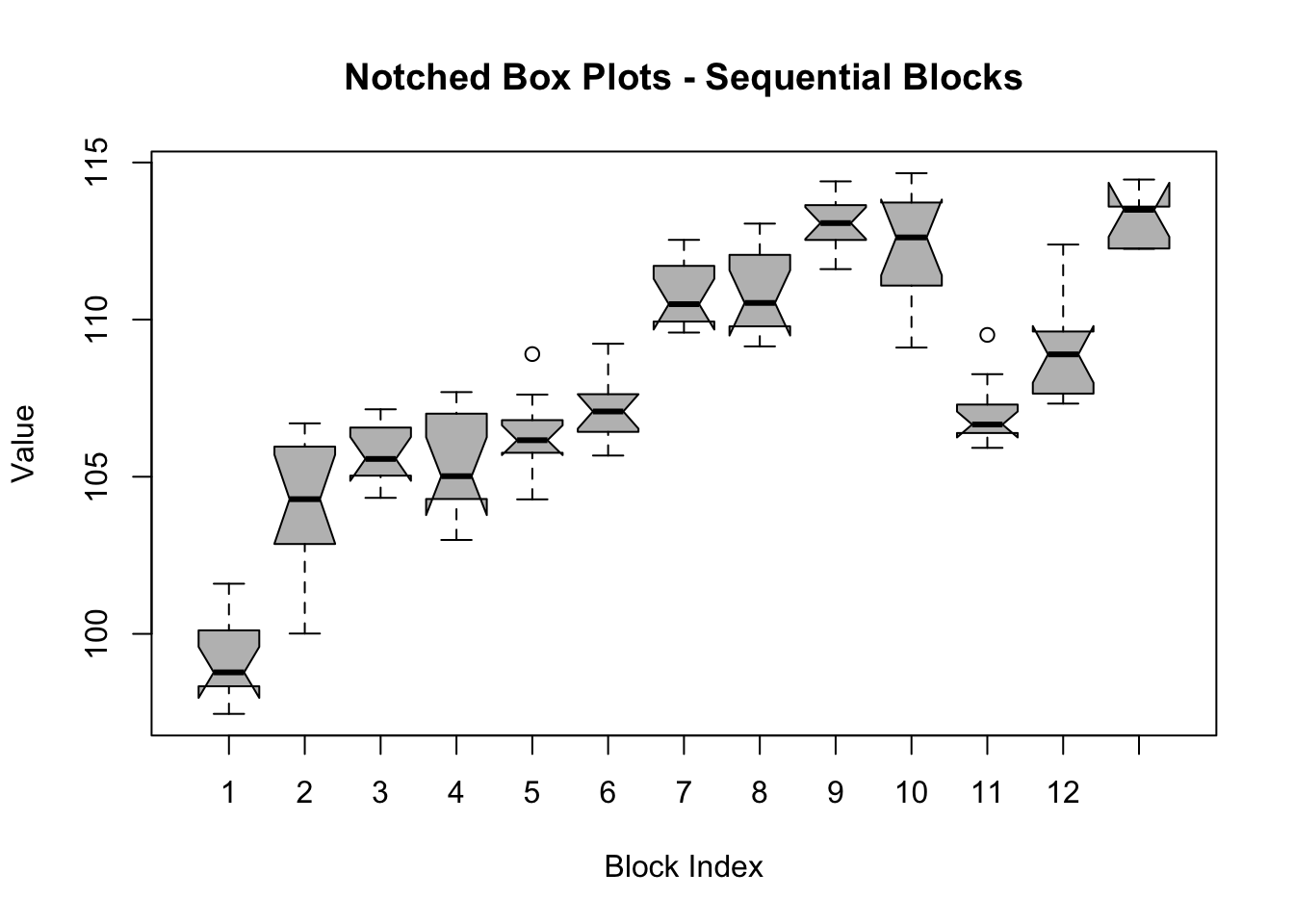
  • The Notched Boxplots for sequential subseries simply computes Notched Boxplots for groups of data which are placed in chronological order. The first Boxplot corresponds to the first “blockwidth” number of observations. The second Boxplot is based on the next “blockwidth” number of observations, and so on.

The blockwidth parameter is usually chosen equal to the seasonal period (i.e. 12 for monthly time series, 4 for quarterly time series, etc.). The periodic index indicates the number of the periodic subseries. If the blockwidth is chosen equal to 12 (assuming we are investigating a monthly time series for which the first observation is a January) then the periodic subseries of index 1 corresponds to all the observations in January. Likewise, the periodic subseries of index 2 corresponds to all observations of the month February, etc.

88.1.1 Horizontal axis

The horizontal axis represents the periodic index (charts 1-5), or sequential index (chart 6).

88.1.2 Vertical axis

The vertical axis shows the value of the time series for which Central Tendency measures are computed.

88.2 R Module

88.2.1 Public website

The Mean Plot is available on the public website:

  • https://compute.wessa.net/rwasp_meanplot.wasp

88.2.2 RFC

The Mean Plot is also available in RFC (when using the default profile) under the “Time Series / Mean Plot” menu item.

To compute the Mean Plot on your local machine, the following script can be used in the R console:

x <- 100 + cumsum(rnorm(150))
summary(x)
par1 <- 12
n <- length(x)
np <- floor(n / par1)
arr <- array(NA,dim=c(par1,np+1))
darr <- array(NA,dim=c(par1,np+1))
ari <- array(0,dim=par1)
dx <- diff(x)
j <- 0
for (i in 1:n) {
  j = j + 1
  ari[j] = ari[j] + 1
  arr[j,ari[j]] <- x[i]
  darr[j,ari[j]] <- dx[i]
  if (j == par1) j = 0
}
arr.mean <- array(NA,dim=par1)
arr.median <- array(NA,dim=par1)
arr.midrange <- array(NA,dim=par1)
for (j in 1:par1) {
  arr.mean[j] <- mean(arr[j,],na.rm=TRUE)
  arr.median[j] <- median(arr[j,],na.rm=TRUE)
  arr.midrange[j] <- (max(arr[j,],na.rm=TRUE) + min(arr[j,],na.rm=TRUE)) / 2
}
overall.mean <- mean(x)
overall.median <- median(x)
overall.midrange <- (max(x,na.rm=TRUE) + min(x,na.rm=TRUE)) / 2
plot(arr.mean,type='b',ylab='mean',main='Mean Plot',xlab='Periodic Index')
mtext(paste('#blocks = ',np))
abline(overall.mean,0)

plot(arr.median,type='b',ylab='median',main='Median Plot',xlab='Periodic Index')
mtext(paste('#blocks = ',np))
abline(overall.median,0)

plot(arr.midrange,type='b',ylab='midrange',main='Midrange Plot',xlab='Periodic Index')
mtext(paste('#blocks = ',np))
abline(overall.midrange,0)

z <- data.frame(t(arr))
names(z) <- c(1:par1)
boxplot(z,notch=TRUE,col='grey',xlab='Periodic Index',ylab='Value',main='Notched Box Plots - Periodic Subseries')
Warning in (function (z, notch = FALSE, width = NULL, varwidth = FALSE, : some
notches went outside hinges ('box'): maybe set notch=FALSE

z <- data.frame(t(darr))
names(z) <- c(1:par1)
boxplot(z,notch=TRUE,col='grey',xlab='Periodic Index',ylab='Value',main='Notched Box Plots - Differenced Periodic Subseries')
Warning in (function (z, notch = FALSE, width = NULL, varwidth = FALSE, : some
notches went outside hinges ('box'): maybe set notch=FALSE

z <- data.frame(arr)
names(z) <- c(1:np)
boxplot(z,notch=TRUE,col='grey',xlab='Block Index',ylab='Value',main='Notched Box Plots - Sequential Blocks')
Warning in (function (z, notch = FALSE, width = NULL, varwidth = FALSE, : some
notches went outside hinges ('box'): maybe set notch=FALSE

z <- data.frame(cbind(arr.mean,arr.median,arr.midrange))
names(z) <- list('mean','median','midrange')
boxplot(z,notch=TRUE,col='grey',ylab='Overall Central Tendency',main='Notched Box Plots')
Warning in (function (z, notch = FALSE, width = NULL, varwidth = FALSE, : some
notches went outside hinges ('box'): maybe set notch=FALSE

   Min. 1st Qu.  Median    Mean 3rd Qu.    Max. 
  97.45  105.68  107.37  107.80  111.17  114.66 

To compute the Mean Plot, the R code uses the following functions from the base R installation: plot, boxplot, mean, median, and quantile. The univariate time series is a simulated Random-Walk.

88.3 Purpose

The Mean Plot allows us to investigate whether or not the Arithmetic Mean varies between sequential or seasonal groups of data. This provides information about the presence of non-seasonal and seasonal trends in time series.

88.4 Pros & Cons

88.4.1 Pros

The Mean Plot has the following advantages:

  • It provides a lot of information about the structural properties of time series.
  • It is easy to interpret.
  • It can also be used to test whether the prediction errors of a forecasting model satisfy the underlying assumptions of the model.

88.4.2 Cons

The Mean Plot has the following disadvantages:

  • Most readers are not familiar with this type of analysis.
  • There are only few software packages which allow the Mean Plot to be computed.

88.5 Example

Consider the famous Airline time series which spans a period of 12 years -- hence, it has a total of \(T = 12*12 = 144\) observations. The Mean Plot in the following analysis shows 12 points, one for each month. Since the time series starts in January, the first point on the chart represents the Arithmetic Mean of all observations in January (since there are exactly 12 years, this mean is computed as \(M_i = \frac{1}{12} \sum_{j=1}^{12} Y_{12 \times (j-1) + i}\) for periodic index \(i = 1, 2, …, 12\)). It can be observed that the number of passengers is higher than the overall average (of about 280) during the summer (\(i = 6, 7, 8, 9\)) while the other months fall below the overall average.

Interactive Shiny app (click to load).
Open in new tab

The Median Plot displays the median for each periodic index (i.e. month) instead of the Arithmetic Mean. The shape of the Median Plot is the same as that of the Mean Plot which is typically the case for time series with strong seasonality.

The Midrange Plot uses the midrange for each periodic index instead of the Median or Arithmetic Mean. Again, the shape is very similar to the previous plots which strengthens our confidence that there is a typical seasonal pattern in the data.

Let us test the hypothesis that the time series exhibits a seasonal pattern based on the notches that are displayed in the plot and which can be interpreted as the confidence intervals for the median. The horizontal bars in the middle of each boxplot represents the Median of the corresponding periodic index (month). The summer period exhibits higher Median values than the remainder of the year. On the other hand, however, the notches for each of these Medians are overlapping which implies that the differences can be attributed to chance.

The observation that the Medians of different months are not different (but equal) comes as a surprise and does not correspond to what we see in Section 87.5. The Time Plot clearly shows a regular seasonal pattern which is repeated in every year. So which conclusion is correct?

The Boxplots of the Differenced Periodic Subseries allows us to explain this contradiction and answer the question unambiguously. When we compute the Notched Box Plots for the differenced time series (i.e. \(Y_t - Y_{t-1}\) instead of \(Y_t\)) then the long-run trend is removed from the series. As a consequence, the seasonal pattern is no longer obfuscated by the presence of a non-seasonal trend, which is exactly why the Differenced Periodic Subseries shows a much clearer picture of the underlying seasonality (observe how most of the Medians have notches that do no longer overlap each other).

Note that when a time series is differenced, the first observation is lost because \(Y_t - Y_{t-1}\) can only be computed for \(t = 2, 3, …, T\). Hence, the first observation of the Airline time series, after differencing, is now the month of February. The interpretation of the periodic index in the differenced and non-differenced plot is, therefore, different!

The first conclusion is that the time series under investigation does, indeed, exhibit a strong seasonal pattern. The second conclusion is that the rate of change in periodic index \(i = 2, 5, 6, and 11\) (i.e. months 3, 6, 7, and 12) are systematically positive. On the other hand, in months 9, 10, and 11 the rate of change is systematically negative.

From the Notched Box Plots of sequential years (we used a blockwidth parameter = 12) it can be concluded that the long-run trend is very strong, causing the Medians of successive years to increase. Also observe how the notches of Medians which are two or three years apart, do not overlap. The conclusion is that the time series under investigation exhibits a non-seasonal (i.e. long-run) trend.

88.6 Task

Compute the Mean Plot for the monthly Marriages time series and describe your conclusions.
87  Time Series Plot (Run Sequence Plot)
89  Blocked Bootstrap Plot (Central Tendency)

© 2026 Patrick Wessa. Provided as-is, without warranty.

Feedback: e-mail | Anonymous contributions: click to copy (Sats) | click to copy (XMR)

Cookie Preferences