The Noncentral t distribution is the key distribution behind statistical power analysis for t-tests. Whenever a researcher asks how many observations do I need? or what is the probability that my study will detect a real effect?, the answer relies on the Noncentral t distribution.
Formally, the random variate \(X\) defined for the range \(-\infty < X < +\infty\), is said to have a Noncentral t Distribution (i.e. \(X \sim \text{t}(n, \delta)\)) with degrees of freedom \(n > 0\) and noncentrality parameter \(\delta \in \mathbb{R}\).
Construction. If \(Z \sim \text{N}(\delta, 1)\) and \(V \sim \chi^2(n)\) are independent, then
\[
T = \frac{Z}{\sqrt{V/n}} \sim \text{t}(n, \delta)
\]
When \(\delta = 0\), this reduces to the standard (central) Student t distribution (see Chapter 25). The noncentrality parameter \(\delta\) shifts the distribution away from zero, reflecting the presence of a true effect.
47.1 Probability Density Function
The PDF of the Noncentral t distribution involves a confluent hypergeometric function and does not have a simple closed form. It can be expressed as
In practice, R computes the density with dt(x, df, ncp).
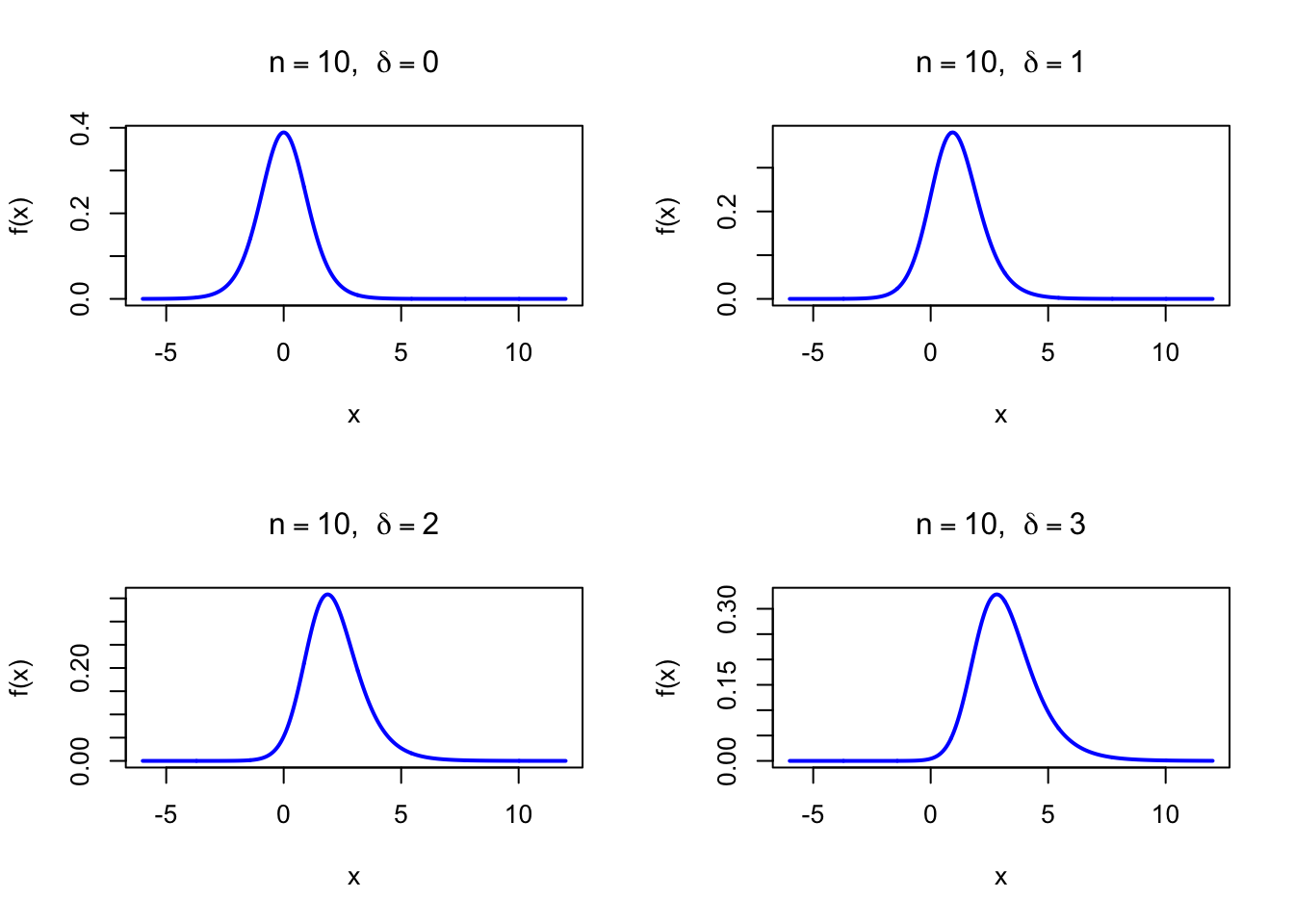
The figure below shows the Noncentral t Probability Density Function for \(n = 10\) and several values of \(\delta\).
Code
par(mfrow =c(2, 2))x <-seq(-6, 12, length =1000)plot(x, dt(x, df =10, ncp =0), type ="l", lwd =2, col ="blue",xlab ="x", ylab ="f(x)", main =expression(paste(n ==10, ", ", delta ==0)))plot(x, dt(x, df =10, ncp =1), type ="l", lwd =2, col ="blue",xlab ="x", ylab ="f(x)", main =expression(paste(n ==10, ", ", delta ==1)))plot(x, dt(x, df =10, ncp =2), type ="l", lwd =2, col ="blue",xlab ="x", ylab ="f(x)", main =expression(paste(n ==10, ", ", delta ==2)))plot(x, dt(x, df =10, ncp =3), type ="l", lwd =2, col ="blue",xlab ="x", ylab ="f(x)", main =expression(paste(n ==10, ", ", delta ==3)))par(mfrow =c(1, 1))
Figure 47.1: Noncentral t Probability Density Function (df = 10) for various noncentrality values
47.2 Purpose
The Noncentral t distribution is the theoretical backbone of power analysis for t-tests. Its primary applications include:
Sample size planning: determining how many observations are needed to detect a given effect size with a desired power level
Power analysis: computing the probability of rejecting the null hypothesis when a true effect of specified size exists
Clinical trial design: justifying sample sizes in protocols for regulatory submissions
Grant proposals: providing statistical justification for the planned study size
Understanding Type II error: quantifying the probability of failing to detect a real effect (\(\beta = 1 - \text{power}\))
Relation to the t-test. Under the null hypothesis (\(H_0: \mu = \mu_0\)), the t statistic follows a central t distribution (with \(\delta = 0\)). Under the alternative hypothesis (\(H_1: \mu = \mu_1 \neq \mu_0\)), the t statistic follows a Noncentral t distribution with a noncentrality parameter that depends on the true effect size and the sample size.
47.3 Distribution Function
There is no elementary closed form for the CDF. It is computed numerically by pt(x, df, ncp) in R.
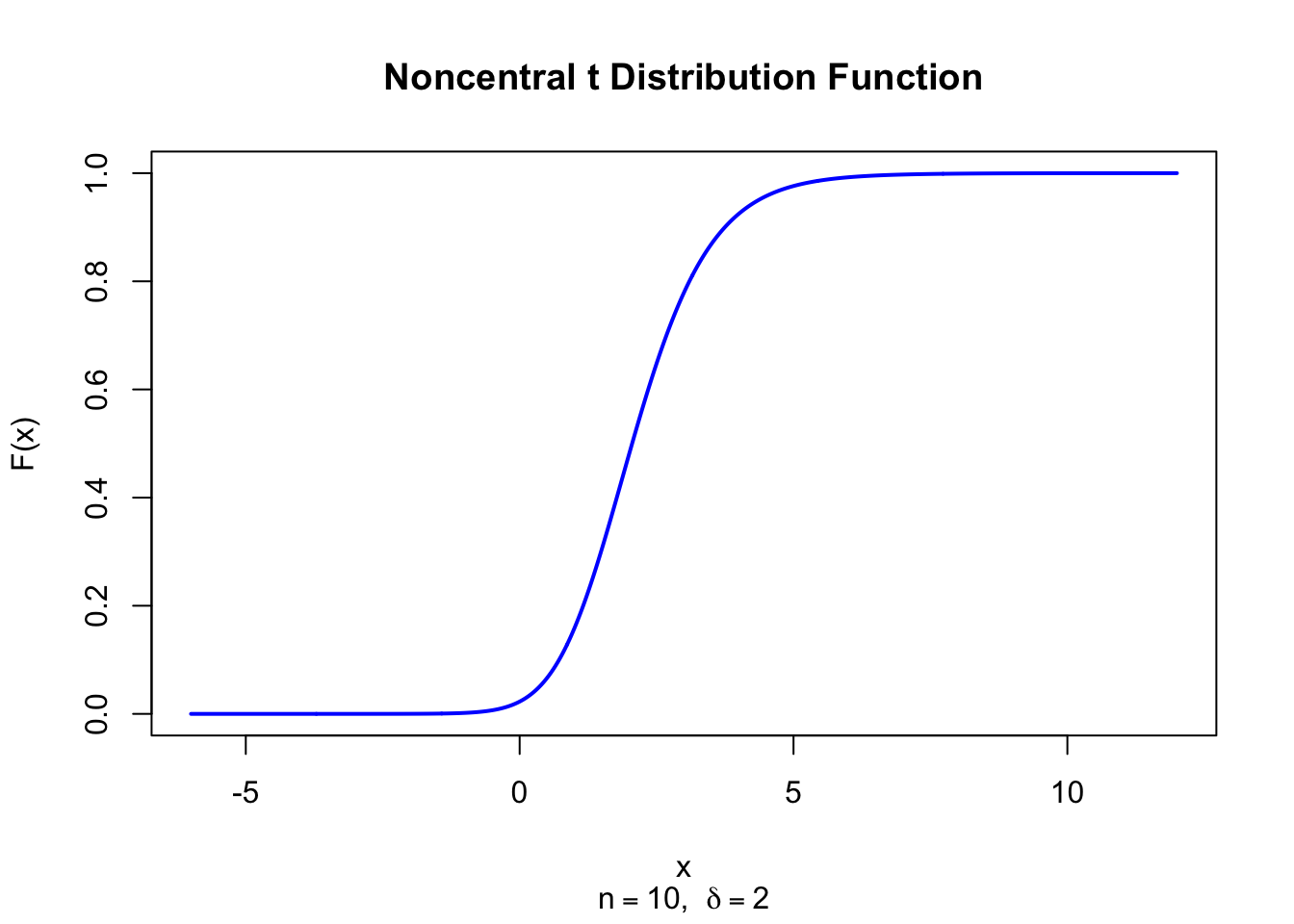
The figure below shows the Noncentral t Distribution Function for \(n = 10\) and \(\delta = 2\).
Code
x <-seq(-6, 12, length =1000)plot(x, pt(x, df =10, ncp =2), type ="l", lwd =2, col ="blue",xlab ="x", ylab ="F(x)", main ="Noncentral t Distribution Function",sub =expression(paste(n ==10, ", ", delta ==2)))
Figure 47.2: Noncentral t Distribution Function (df = 10, delta = 2)
47.4 Moment Generating Function
The moment generating function of the Noncentral t distribution does not have a simple closed form. Moments are typically computed from the recursive formulas below.
There is no closed-form expression for the median. It is computed numerically via qt(0.5, df, ncp) in R:
# Median for t(n = 10, delta = 2)qt(0.5, df =10, ncp =2)
[1] 2.053691
47.8 Mode
The mode of the Noncentral t distribution does not have a simple closed-form expression. It can be found numerically by maximizing the density function. For moderate to large \(n\) and \(\delta > 0\), the mode is approximately equal to \(\delta\).
47.9 Coefficient of Skewness
The Noncentral t distribution is skewed. For \(\delta > 0\) the distribution is right-skewed, and for \(\delta < 0\) it is left-skewed. The skewness depends on both \(n\) and \(\delta\) and does not simplify to a compact formula. It can be computed numerically from the centered moments.
When \(\delta = 0\) (central case), the skewness is zero by symmetry. As \(n \to \infty\), the skewness approaches that of \(\text{N}(\delta, 1)\), which is zero.
47.10 Coefficient of Kurtosis
The kurtosis of the Noncentral t distribution depends on both \(n\) and \(\delta\) and requires \(n > 4\) for existence. It exceeds the Normal kurtosis of 3, indicating heavier tails. As \(n \to \infty\), the kurtosis approaches 3.
47.11 Parameter Estimation
The Noncentral t distribution is not typically fitted to data via parameter estimation in the classical sense. Instead, the noncentrality parameter \(\delta\) is determined from the experimental design:
One-sample or paired t-test: \(\delta = \sqrt{n} \cdot d\), where \(d = (\mu_1 - \mu_0)/\sigma\) is the standardized effect size and \(n\) is the sample size
Independent two-sample t-test (equal group sizes): \(\delta = \sqrt{n/2} \cdot d\), where \(d = (\mu_1 - \mu_2)/\sigma\) is Cohen’s \(d\) and \(n\) is the total number of observations per group
Given an observed t statistic, a confidence interval for \(\delta\) can be obtained by inverting the CDF using qt().
47.12 R Module
47.12.1 RFC
The Noncentral t Distribution module is available in RFC under the menu “Distributions / Noncentral t Distribution”.
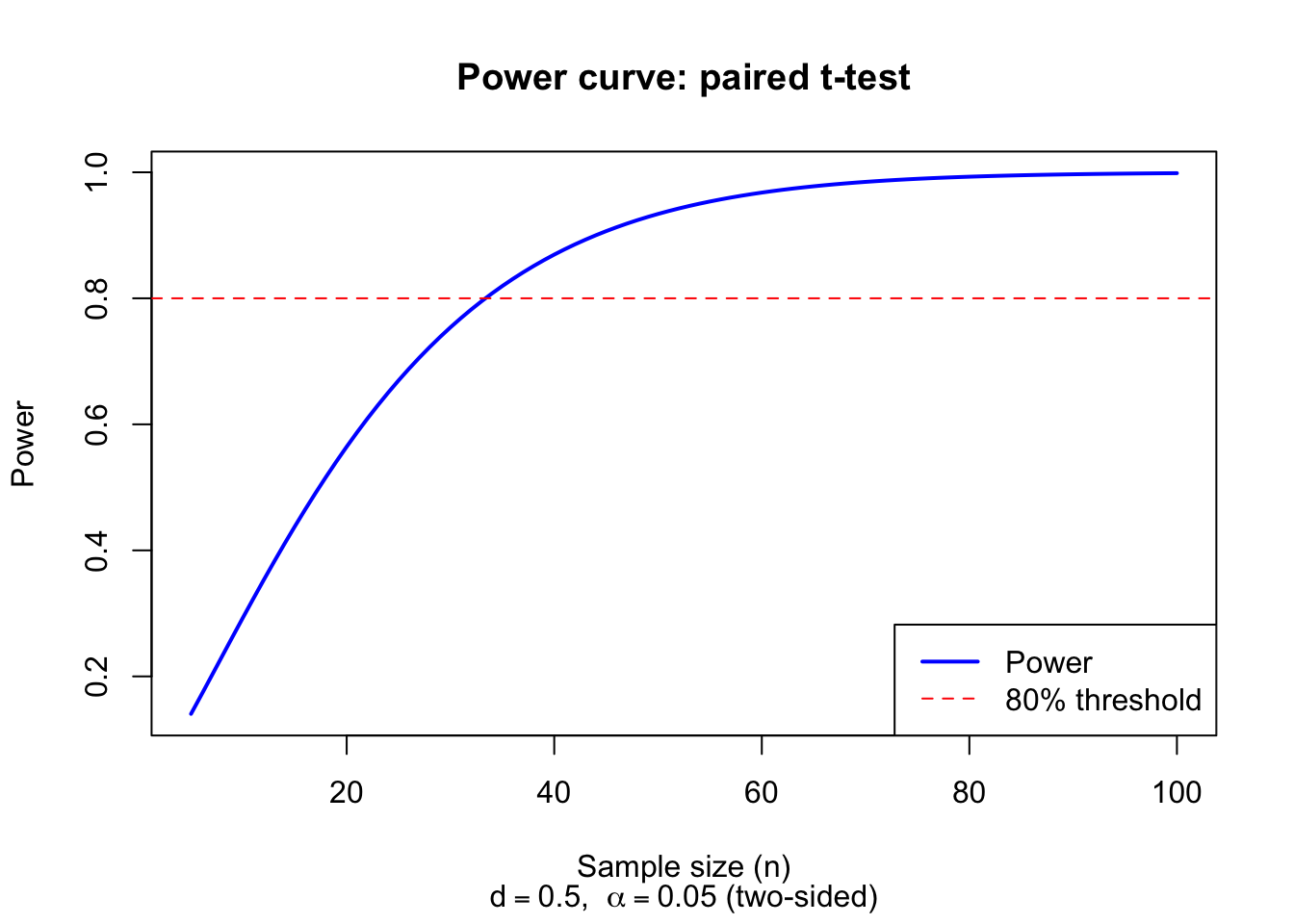
A clinical researcher plans a paired t-test to detect a standardized effect size of \(d = 0.5\) (a medium effect by Cohen’s conventions). Using a two-sided test at \(\alpha = 0.05\), how many subjects are required to achieve 80% power?
The noncentrality parameter for a paired t-test is \(\delta = \sqrt{n} \cdot d\), and the degrees of freedom are \(n - 1\). We compute power for various sample sizes:
d <-0.5# standardized effect sizealpha <-0.05# significance level (two-sided)# Compute power for sample sizes from 10 to 80n_vals <-seq(10, 80, by =5)power <-numeric(length(n_vals))for (i inseq_along(n_vals)) { n <- n_vals[i] df <- n -1 delta <-sqrt(n) * d t_crit <-qt(1- alpha/2, df = df)# Power = P(|T| > t_crit) under the alternative power[i] <-1-pt(t_crit, df = df, ncp = delta) +pt(-t_crit, df = df, ncp = delta)}result <-data.frame(n = n_vals, delta =sqrt(n_vals) * d, power =round(power, 4))print(result)# Find minimum sample size for 80% powern_required <- n_vals[which(power >=0.80)[1]]cat("\nMinimum sample size for 80% power:", n_required, "\n")
Random variates from the Noncentral t distribution can be generated directly from its construction. If \(Z \sim \text{N}(\delta, 1)\) and \(V \sim \chi^2(n)\) are independent, then \(T = Z / \sqrt{V/n}\) follows \(\text{t}(n, \delta)\).
set.seed(123)N <-1000n <-10delta <-2# Construction methodz <-rnorm(N, mean = delta, sd =1)v <-rchisq(N, df = n)x_construct <- z /sqrt(v / n)# Built-in functionx_rt <-rt(N, df = n, ncp = delta)cat("Construction: mean =", round(mean(x_construct), 4)," var =", round(var(x_construct), 4), "\n")cat("rt(): mean =", round(mean(x_rt), 4)," var =", round(var(x_rt), 4), "\n")# Theoretical meanE_theory <- delta *sqrt(n/2) *gamma((n-1)/2) /gamma(n/2)cat("Theoretical: mean =", round(E_theory, 4), "\n")
Construction: mean = 2.1936   var = 1.5229
rt():         mean = 2.1582   var = 1.636
Theoretical:  mean = 2.1674
Code
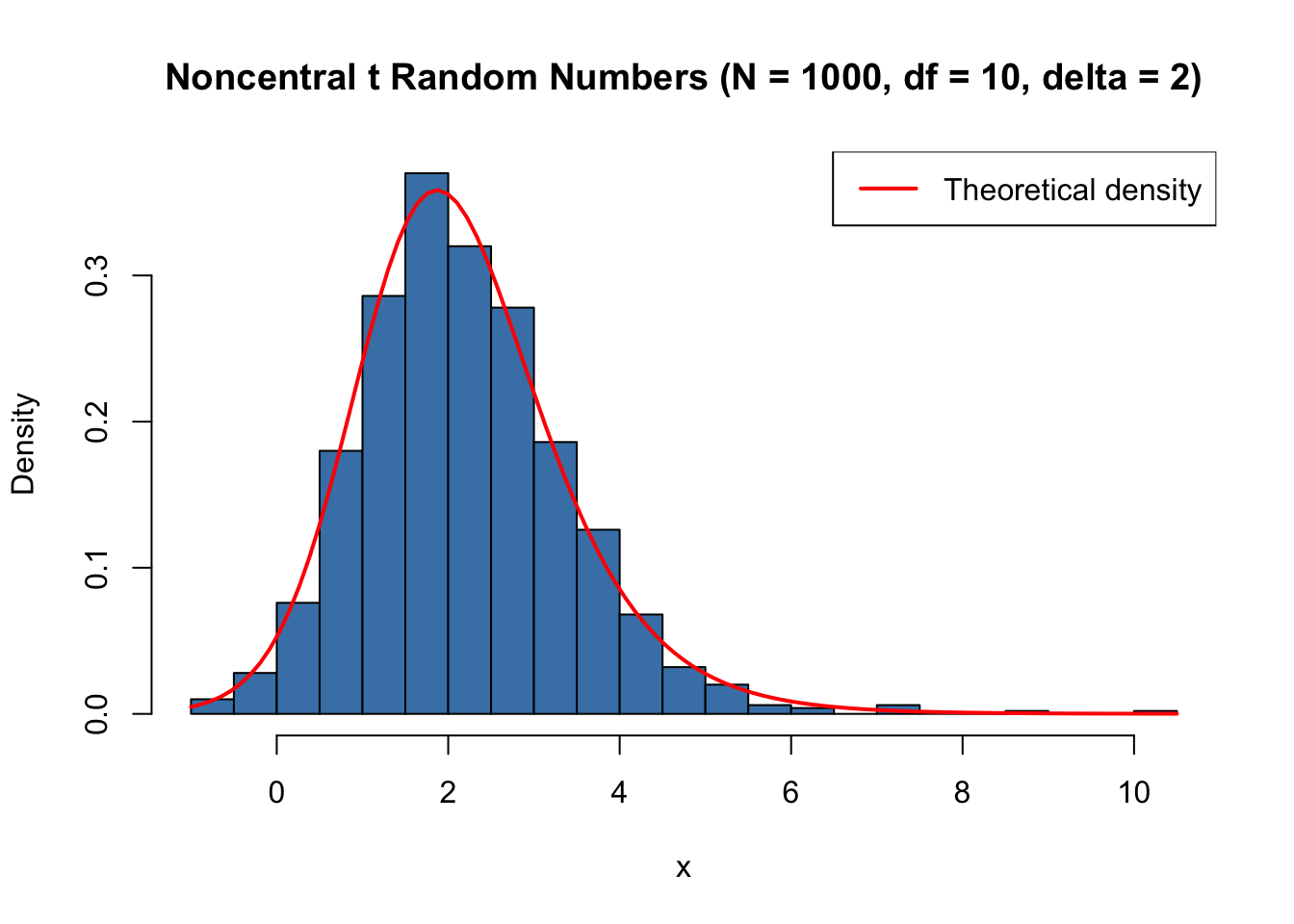
set.seed(123)x <-rt(1000, df =10, ncp =2)hist(x, breaks =40, col ="steelblue", freq =FALSE,xlab ="x", main ="Noncentral t Random Numbers (N = 1000, df = 10, delta = 2)")curve(dt(x, df =10, ncp =2), add =TRUE, col ="red", lwd =2)legend("topright", legend ="Theoretical density", col ="red", lwd =2)
Figure 47.4: Histogram of simulated Noncentral t random numbers (N = 1000, df = 10, delta = 2)
The noncentrality parameter \(\delta\) determines the statistical power of a t-test. Under the alternative hypothesis, the t statistic follows \(\text{t}(n-1, \delta)\) for a one-sample or paired test. Power is the probability that \(|T|\) exceeds the critical value:
\[
\text{Power} = 1 - \text{P}\!\left(-t_{\alpha/2, n-1} \leq T \leq t_{\alpha/2, n-1}\right) \quad \text{where } T \sim \text{t}(n-1, \delta)
\]
As \(\delta\) increases (larger effect or larger sample), the Noncentral t density shifts further from zero, and a greater proportion of its area falls beyond the critical values, yielding higher power.
47.16 Property 2: Noncentrality Formulas for t-tests
The noncentrality parameter links the effect size, sample size, and the t distribution:
47.20 Related Distributions 3: Chi-squared Connection
The construction of the Noncentral t distribution involves a Chi-squared variate in the denominator. Specifically, if \(V \sim \chi^2(n)\) (see Chapter 23), the square root \(\sqrt{V/n}\) provides the scaling.
47.21 Related Distributions 4: Link with the Noncentral F Distribution
The square of a Noncentral t variate with \(n\) degrees of freedom and noncentrality \(\delta\) follows a Noncentral F distribution (see Chapter 48):
\[
T^2 = \text{F}(1, n, \delta^2) \quad \text{where } T \sim \text{t}(n, \delta)
\]
This relationship connects power analysis for t-tests to power analysis for F-tests with numerator degrees of freedom equal to 1.
47.22 Related Distributions 5: Noncentral Chi-squared Connection
The noncentrality parameter \(\delta^2\) of the squared Noncentral t variate corresponds to the noncentrality of the Noncentral Chi-squared distribution (see Chapter 24). Specifically, in the numerator of the construction, \(Z^2 \sim \chi^2(1, \delta^2)\) where \(Z \sim \text{N}(\delta, 1)\).