The Maxwell-Boltzmann distribution describes the speed of particles in an ideal gas at thermal equilibrium. It is one of the cornerstones of statistical mechanics and kinetic theory, connecting the macroscopic quantity temperature to the microscopic distribution of molecular speeds.
Formally, the random variate \(V\) defined for the range \(V \geq 0\), is said to have a Maxwell-Boltzmann Distribution (i.e. \(V \sim \text{Maxwell}(a)\)) with scale parameter \(a > 0\). In the physical context, \(a = \sqrt{k_BT/m}\) where \(k_B\) is the Boltzmann constant, \(T\) is the absolute temperature, and \(m\) is the molecular mass. The Maxwell-Boltzmann distribution is a scaled Chi distribution with \(k = 3\) degrees of freedom: if \(X \sim \chi(3)\) then \(aX \sim \text{Maxwell}(a)\).
50.1 Probability Density Function
\[
f(v) = \sqrt{\frac{2}{\pi}}\,\frac{v^2}{a^3}\,\exp\!\left(-\frac{v^2}{2a^2}\right), \quad v \geq 0
\]
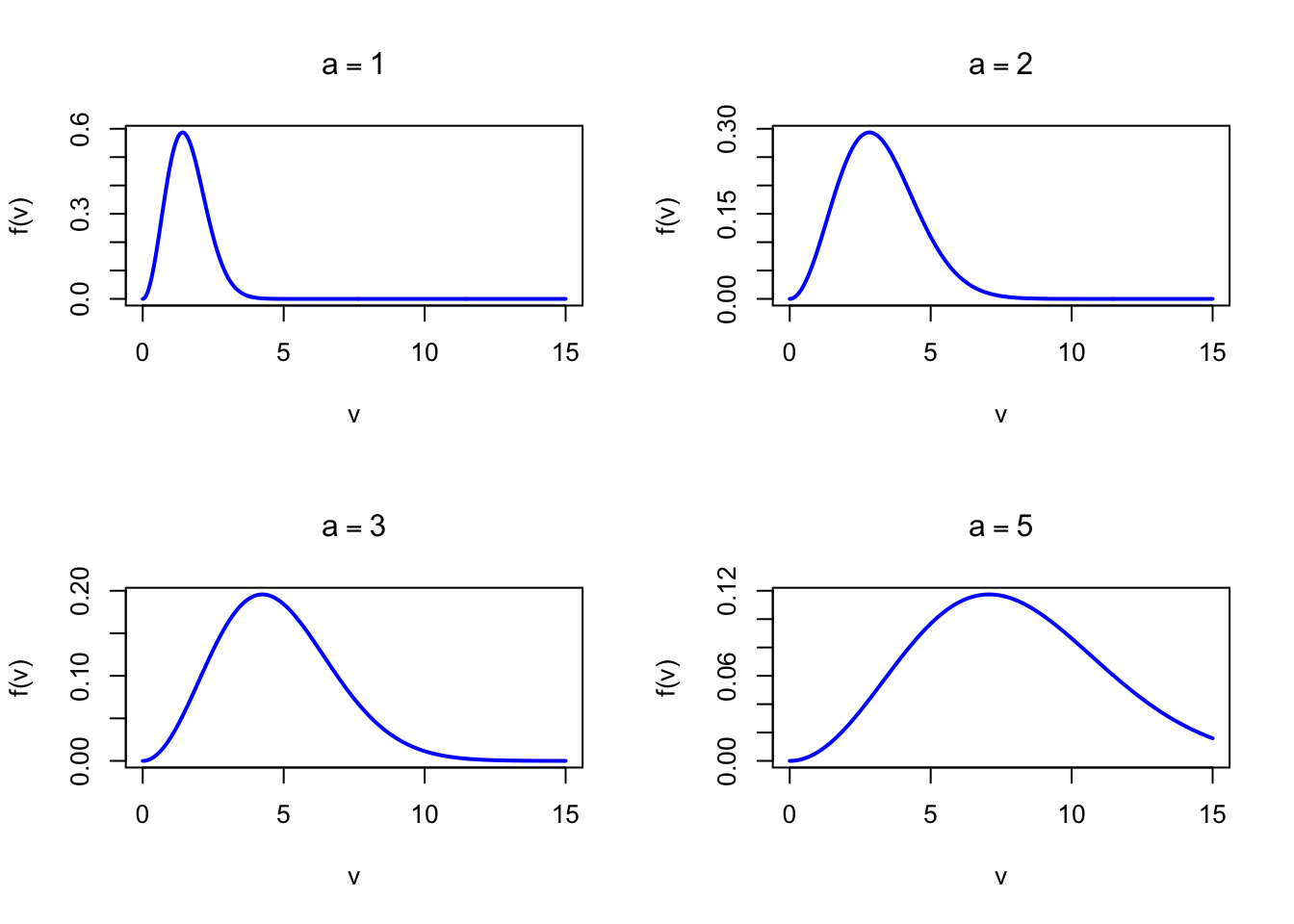
The figure below shows examples of the Maxwell-Boltzmann Probability Density Function for different scale values.
Code
dmaxwell <-function(v, a) {ifelse(v >=0, sqrt(2/pi) * v^2/ a^3*exp(-v^2/ (2* a^2)), 0)}par(mfrow =c(2, 2))v <-seq(0, 15, length =500)plot(v, dmaxwell(v, 1), type ="l", lwd =2, col ="blue",xlab ="v", ylab ="f(v)", main =expression(a ==1))plot(v, dmaxwell(v, 2), type ="l", lwd =2, col ="blue",xlab ="v", ylab ="f(v)", main =expression(a ==2))plot(v, dmaxwell(v, 3), type ="l", lwd =2, col ="blue",xlab ="v", ylab ="f(v)", main =expression(a ==3))plot(v, dmaxwell(v, 5), type ="l", lwd =2, col ="blue",xlab ="v", ylab ="f(v)", main =expression(a ==5))par(mfrow =c(1, 1))
Figure 50.1: Maxwell-Boltzmann Probability Density Function for various scale values
50.2 Purpose
The Maxwell-Boltzmann distribution is the fundamental speed distribution for particles in thermal equilibrium. It connects microscopic particle dynamics to macroscopic thermodynamic properties and underpins much of statistical physics. Common applications include:
Kinetic theory of gases: distribution of molecular speeds at a given temperature
Molecular dynamics simulations: initialization and validation of velocity distributions
Diffusion modeling: relating diffusion coefficients to particle speed distributions
Stellar atmospheres: spectral line broadening from thermal Doppler shifts
Thermodynamic equilibrium: deriving transport properties (viscosity, thermal conductivity)
Relation to the Chi distribution. The Maxwell-Boltzmann distribution is the Chi distribution with \(k = 3\) degrees of freedom, scaled by \(a\). This arises because the speed \(v = \sqrt{v_x^2 + v_y^2 + v_z^2}\) is the Euclidean norm of three independent \(N(0, a^2)\) velocity components.
where \(\text{erf}(z) = \frac{2}{\sqrt{\pi}}\int_0^z e^{-t^2}\,dt\). In R, the CDF can be computed via the Chi-squared distribution: pchisq((v/a)^2, df = 3).
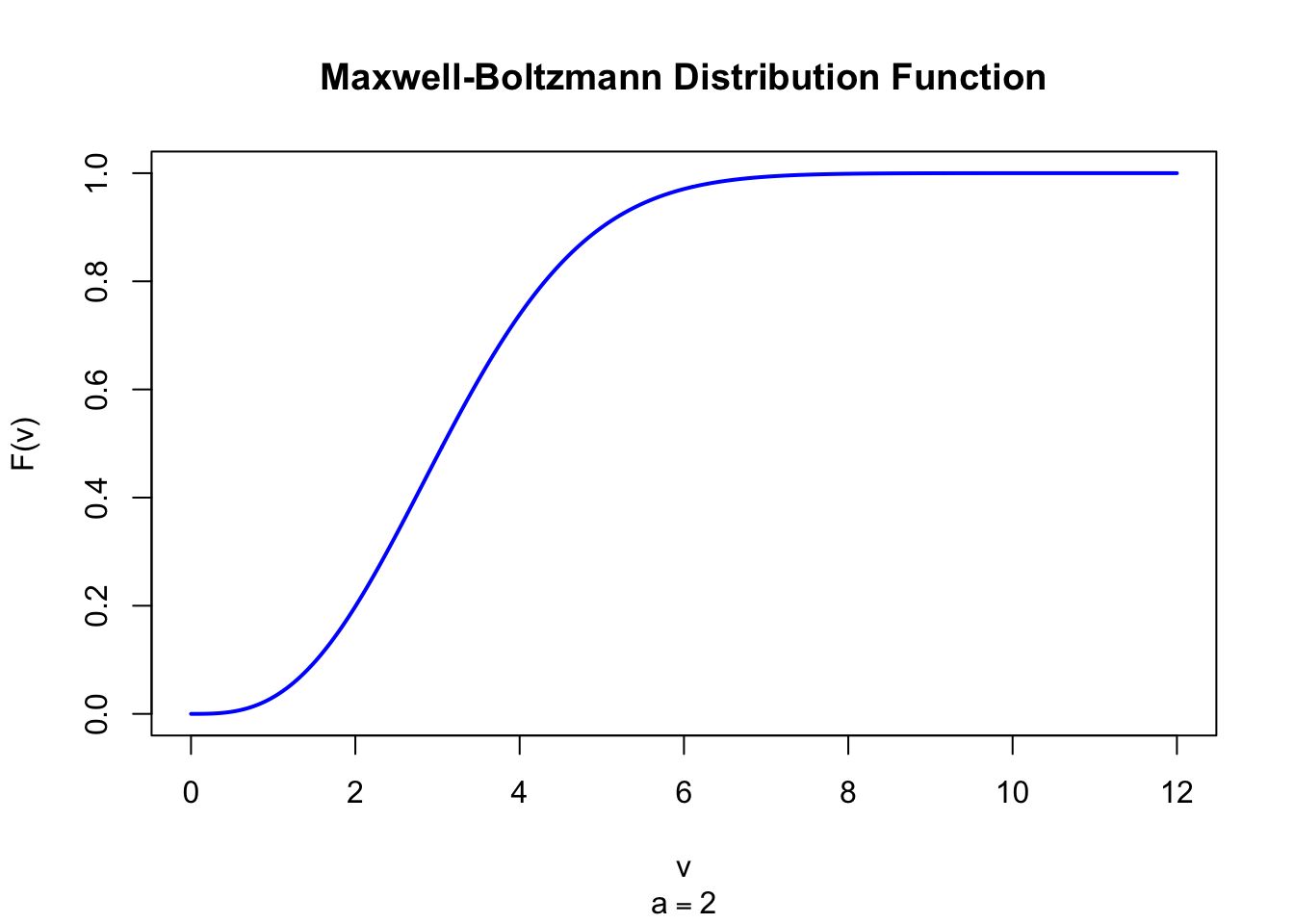
The figure below shows the Maxwell-Boltzmann Distribution Function for \(a = 2\).
Code
pmaxwell <-function(v, a) {ifelse(v >=0, pchisq((v/a)^2, df =3), 0)}v <-seq(0, 12, length =500)plot(v, pmaxwell(v, 2), type ="l", lwd =2, col ="blue",xlab ="v", ylab ="F(v)", main ="Maxwell-Boltzmann Distribution Function",sub =expression(a ==2))
Figure 50.2: Maxwell-Boltzmann Distribution Function (a = 2)
50.4 Moment Generating Function
The moment generating function has no simple closed form. Raw moments are computed directly from the density:
The median has no simple closed form and must be computed numerically:
# Median of Maxwell-Boltzmann(a): numericala <-2pmaxwell <-function(v, a) pchisq((v/a)^2, df =3)uniroot(function(v) pmaxwell(v, a) -0.5, c(0.001, 100))$root
[1] 3.076345
50.8 Mode
\[
\text{Mo}(V) = a\sqrt{2}
\]
The mode is the most probable speed \(v_p\). In the physical context:
The excess kurtosis \(g_2 - 3 \approx 0.108\) is small and positive, indicating slightly heavier tails than the Normal distribution. This is a fixed constant, independent of \(a\).
50.11 Parameter Estimation
The MLE of \(a^2\) is:
\[
\hat a^2 = \frac{1}{3n}\sum_{i=1}^n v_i^2
\]
This follows from the equivalence with the Chi distribution: \(V^2/a^2 \sim \chi^2(3)\), so the sufficient statistic is \(\sum v_i^2\).
The following code demonstrates Maxwell-Boltzmann probability calculations:
a <-2# Custom density functiondmaxwell <-function(v, a) {ifelse(v >=0, sqrt(2/pi) * v^2/ a^3*exp(-v^2/ (2* a^2)), 0)}# Custom CDF using Chi-squaredpmaxwell <-function(v, a) {ifelse(v >=0, pchisq((v/a)^2, df =3), 0)}# Density at v = 3dmaxwell(3, a)# P(V <= 3): distribution functionpmaxwell(3, a)# Characteristic speedscat("Most probable speed (mode):", a *sqrt(2), "\n")cat("Mean speed:", 2* a *sqrt(2/pi), "\n")cat("RMS speed:", a *sqrt(3), "\n")
[1] 0.2914146
[1] 0.4778328
Most probable speed (mode): 2.828427
Mean speed: 3.191538
RMS speed: 3.464102
50.13 Example
Consider nitrogen (\(\text{N}_2\), molar mass \(M = 0.028\) kg/mol) molecules at room temperature \(T = 300\) K. Using \(k_B = 1.380649 \times 10^{-23}\) J/K and \(N_A = 6.02214 \times 10^{23}\) mol\(^{-1}\), the molecular mass is \(m = M/N_A\) and the scale parameter is \(a = \sqrt{k_BT/m}\).
# Physical constantskB <-1.380649e-23# Boltzmann constant (J/K)NA_const <-6.02214076e23# Avogadro's number (1/mol)# Nitrogen at 300 KM <-0.028# Molar mass (kg/mol)T_kelvin <-300# Temperature (K)m <- M / NA_const # Molecular mass (kg)# Scale parametera <-sqrt(kB * T_kelvin / m)# Characteristic speeds (m/s)v_p <- a *sqrt(2)v_avg <-2* a *sqrt(2/pi)v_rms <- a *sqrt(3)cat("Scale parameter a:", round(a, 2), "m/s\n")cat("Most probable speed v_p:", round(v_p, 2), "m/s\n")cat("Mean speed v_avg:", round(v_avg, 2), "m/s\n")cat("RMS speed v_rms:", round(v_rms, 2), "m/s\n")# P(V > 600 m/s) — fraction of fast moleculespmaxwell <-function(v, a) pchisq((v/a)^2, df =3)cat("P(V > 600 m/s):", round(1-pmaxwell(600, a), 4), "\n")
Scale parameter a: 298.47 m/s
Most probable speed v_p: 422.1 m/s
Mean speed v_avg: 476.29 m/s
RMS speed v_rms: 516.96 m/s
P(V > 600 m/s): 0.2571
Maxwell-Boltzmann random variates are generated from three independent Normal variates. Since the speed is the Euclidean norm of the 3D velocity vector:
This makes the Maxwell-Boltzmann distribution the natural model for the speed (magnitude of the velocity vector) of particles whose velocity components are independently and identically normally distributed.
50.16 Property 2: Three Characteristic Speeds
The Maxwell-Boltzmann distribution has three characteristic speeds that appear frequently in kinetic theory:
The most probable speed \(v_p\) (mode) is always less than the mean speed \(\bar{v}\), which is always less than the root-mean-square speed \(v_{\text{rms}}\). Their ratios are universal constants independent of temperature or molecular mass:
If \(V \sim \text{Maxwell}(a)\) then the kinetic energy \(E = \frac{1}{2}mv^2\) follows a Gamma distribution:
\[
E \sim \text{Gamma}\!\left(\frac{3}{2},\, \frac{1}{k_BT}\right)
\]
The mean kinetic energy is \(\text{E}(E) = \frac{3}{2}k_BT\), which is the equipartition theorem result. See Chapter 29.
50.18 Property 4: Constant Shape Statistics
The coefficient of variation, skewness, and kurtosis of the Maxwell-Boltzmann distribution are all universal constants, independent of the scale parameter \(a\) (and therefore independent of temperature and molecular mass):
The Maxwell-Boltzmann distribution is the Chi distribution with \(k = 3\) degrees of freedom, scaled by \(a\): \(\text{Maxwell}(a) = a \cdot \chi(3)\) (see Chapter 22).
50.20 Related Distributions 2: Rayleigh Distribution
The Rayleigh distribution is the 2D analogue of the Maxwell-Boltzmann distribution — it describes the magnitude of a 2D Gaussian vector, whereas the Maxwell-Boltzmann describes the magnitude of a 3D Gaussian vector: \(\text{Rayleigh}(\sigma) = \sigma \cdot \chi(2)\) while \(\text{Maxwell}(a) = a \cdot \chi(3)\) (see Chapter 34).
50.21 Related Distributions 3: Normal Distribution
The individual velocity components \(V_x, V_y, V_z\) each follow a Normal distribution \(N(0, a^2)\), and the Maxwell-Boltzmann distribution arises as the norm of the 3D velocity vector (see Chapter 20).
50.22 Related Distributions 4: Gamma Distribution
The kinetic energy \(E = \frac{1}{2}mv^2\) of a Maxwell-Boltzmann distributed particle follows a Gamma distribution with shape \(3/2\) and rate \(1/(k_BT)\) (see Chapter 29).