The Frechet distribution is the extreme-value distribution for block maxima drawn from heavy-tailed parent distributions. When the underlying data follow a Pareto, Student-\(t\), Cauchy, or any regularly varying distribution, the normalized maximum converges to a Frechet distribution, making it the canonical model for extreme events with potentially unbounded severity.
Formally, the random variate \(X\) defined for the range \(X > m\), is said to have a Frechet Distribution (i.e. \(X \sim \text{Frechet}(\alpha, s, m)\)) with shape parameter \(\alpha > 0\), scale parameter \(s > 0\), and location parameter \(m \geq 0\). The Frechet distribution is also known as the GEV Type II distribution or the inverse Weibull distribution (for maxima). We define \(z = (x - m)/s\) throughout this chapter.
46.1 Probability Density Function
\[
f(x) = \frac{\alpha}{s}\left(\frac{x - m}{s}\right)^{-1-\alpha}\exp\!\left(-\left(\frac{x - m}{s}\right)^{-\alpha}\right), \quad x > m
\]
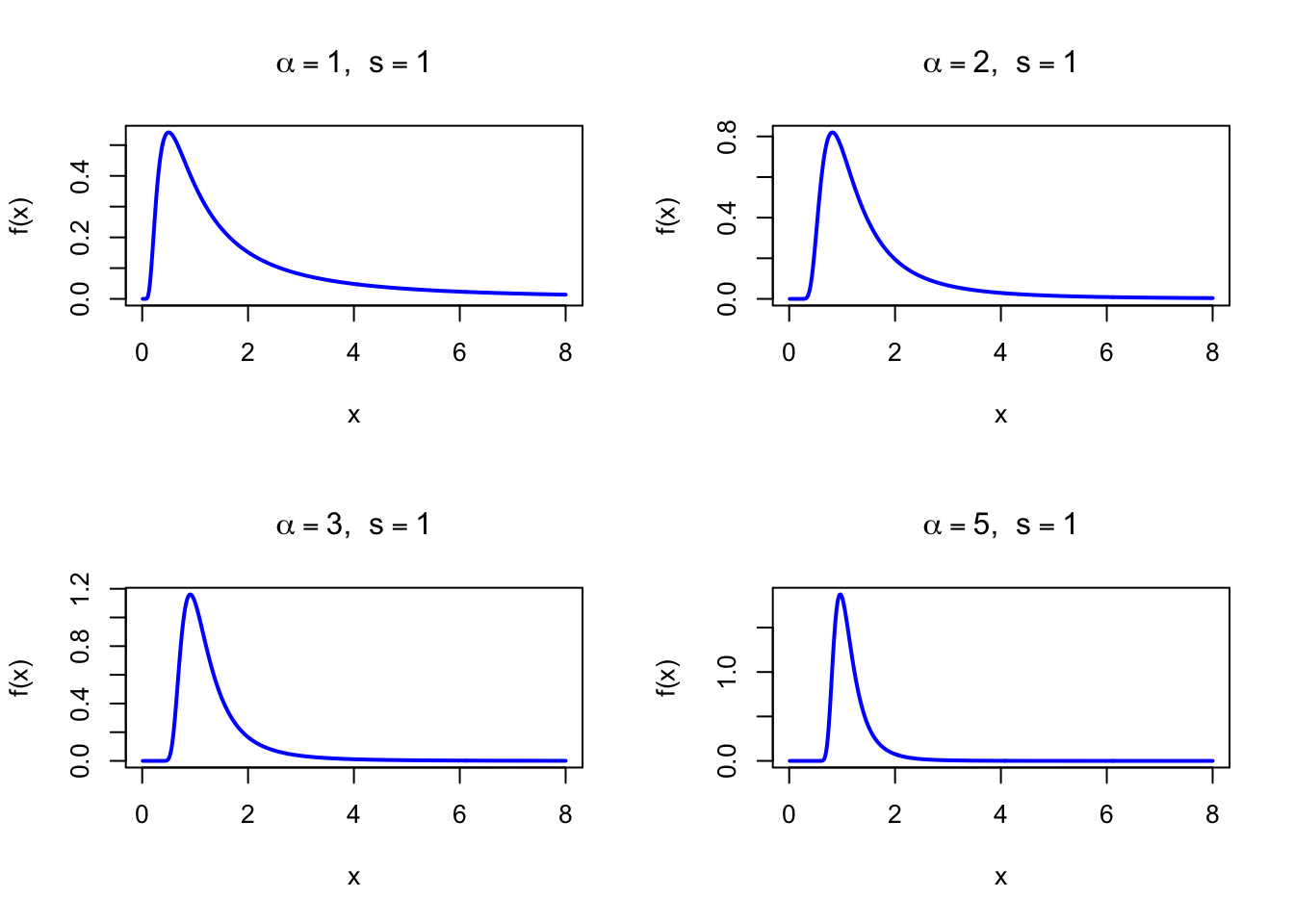
The figure below shows examples of the Frechet Probability Density Function for different shape values with \(s = 1\) and \(m = 0\).
Code
dfrechet <-function(x, alpha, s =1, m =0) { z <- (x - m) / s valid <- z >0 d <-rep(0, length(x)) d[valid] <- (alpha / s) * z[valid]^(-1- alpha) *exp(-z[valid]^(-alpha)) d}par(mfrow =c(2, 2))x <-seq(0.01, 8, length =500)plot(x, dfrechet(x, 1), type ="l", lwd =2, col ="blue",xlab ="x", ylab ="f(x)", main =expression(paste(alpha ==1, ", ", s ==1)))plot(x, dfrechet(x, 2), type ="l", lwd =2, col ="blue",xlab ="x", ylab ="f(x)", main =expression(paste(alpha ==2, ", ", s ==1)))plot(x, dfrechet(x, 3), type ="l", lwd =2, col ="blue",xlab ="x", ylab ="f(x)", main =expression(paste(alpha ==3, ", ", s ==1)))plot(x, dfrechet(x, 5), type ="l", lwd =2, col ="blue",xlab ="x", ylab ="f(x)", main =expression(paste(alpha ==5, ", ", s ==1)))par(mfrow =c(1, 1))
Figure 46.1: Frechet Probability Density Function for various shape values (scale = 1, location = 0)
46.2 Purpose
The Frechet distribution arises as the limiting distribution of block maxima from heavy-tailed parent distributions, whose survival function decays as a power law. Its defining characteristic is a polynomially decaying right tail, which assigns substantially more probability to extreme outcomes than light-tailed models such as the Gumbel. Common applications include:
Extreme financial losses: modeling the largest daily portfolio losses or maximum drawdowns
Catastrophic insurance claims: annual maximum claim sizes in reinsurance
Extreme pollution concentrations: maximum pollutant levels from industrial incidents
Telecommunications traffic peaks: maximum data throughput or congestion events
Extreme precipitation: maximum rainfall intensities in heavy-tailed climatic regimes
Relation to the discrete setting. The Frechet distribution is the continuous limit of the maximum of \(n\) i.i.d. random variables from heavy-tailed parents. In the discrete domain, the normalized maximum of regularly varying discrete distributions (e.g., Zipf, Yule-Simon) also converges to the Frechet distribution after appropriate normalization.
46.3 Distribution Function
\[
F(x) = \exp\!\left(-\left(\frac{x - m}{s}\right)^{-\alpha}\right), \quad x > m
\]
In R (using the evd package): pfrechet(x, loc = m, scale = s, shape = alpha).
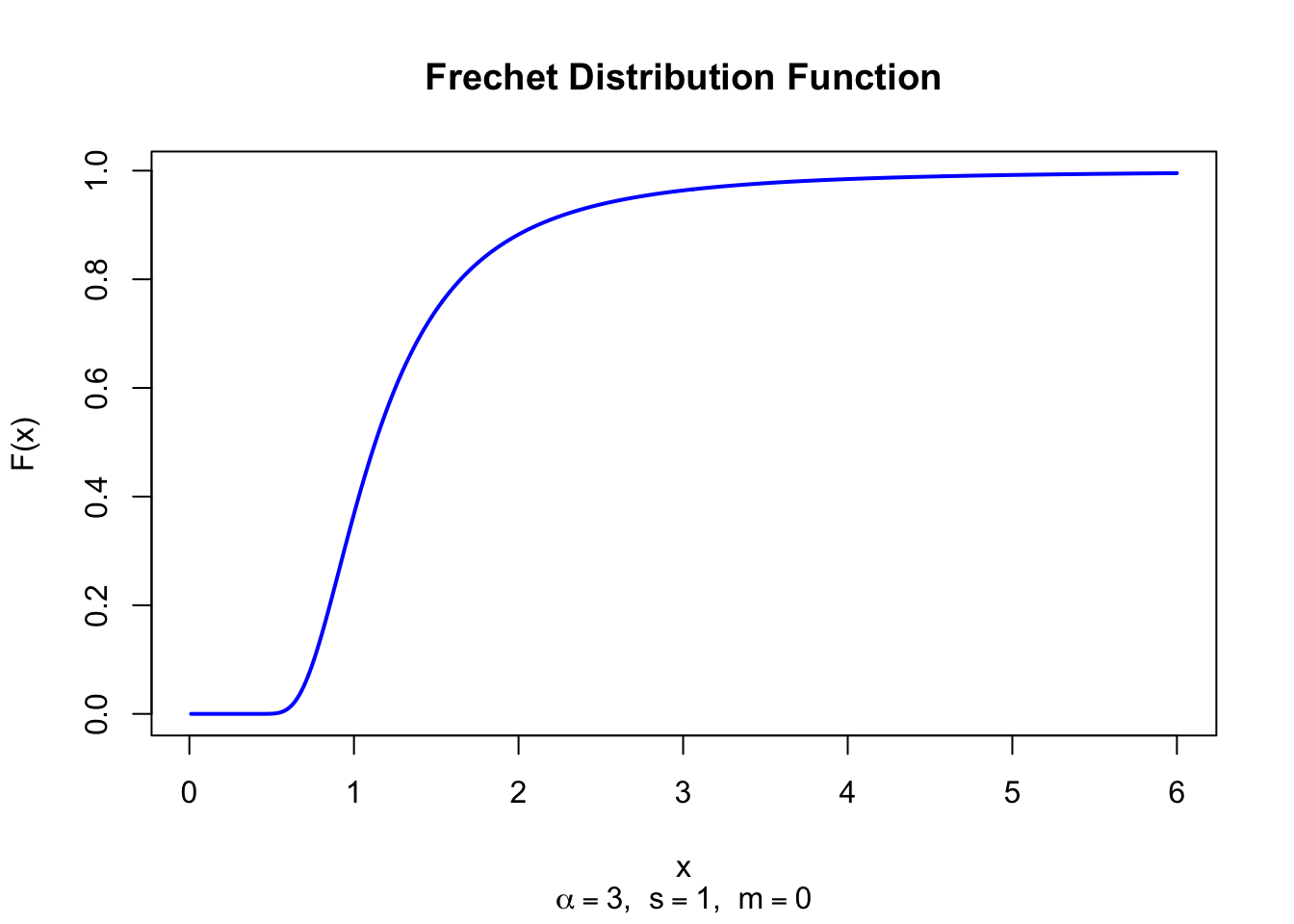
The figure below shows the Frechet Distribution Function for \(\alpha = 3\), \(s = 1\), and \(m = 0\).
Code
pfrechet <-function(x, alpha, s =1, m =0) { z <- (x - m) / s valid <- z >0 p <-rep(0, length(x)) p[valid] <-exp(-z[valid]^(-alpha)) p}x <-seq(0.01, 6, length =500)plot(x, pfrechet(x, 3), type ="l", lwd =2, col ="blue",xlab ="x", ylab ="F(x)", main ="Frechet Distribution Function",sub =expression(paste(alpha ==3, ", ", s ==1, ", ", m ==0)))
Figure 46.2: Frechet Distribution Function (shape = 3, scale = 1, location = 0)
46.4 Moment Generating Function
The moment generating function of the Frechet distribution does not exist in closed form because the heavy right tail causes \(E[e^{tX}]\) to diverge for all \(t > 0\).
Raw moments are expressed in terms of the gamma function:
The skewness is always positive and increases as \(\alpha\) decreases (heavier tail). For \(\alpha \leq 3\), the skewness is undefined because the third moment does not exist.
The following code demonstrates Frechet probability calculations using custom functions and the evd package:
library(evd)alpha <-3; s <-2; m <-0# Custom densitydfrechet <-function(x, alpha, s, m) { z <- (x - m) / s (alpha / s) * z^(-1- alpha) *exp(-z^(-alpha))}# Custom CDFpfrechet <-function(x, alpha, s, m) {exp(-((x - m) / s)^(-alpha))}# Probability density at x = 3dfrechet(3, alpha, s, m)# Distribution function: P(X <= 3)pfrechet(3, alpha, s, m)# Quantile function: medianqfrechet(0.5, loc = m, scale = s, shape = alpha)# Mean and modecat("Mean:", m + s *gamma(1-1/alpha), "\n")cat("Mode:", m + s * (alpha / (alpha +1))^(1/alpha), "\n")cat("Median:", m + s / (log(2))^(1/alpha), "\n")# Generate random Frechet numbersset.seed(42)rfrechet(10, loc = m, scale = s, shape = alpha)
An insurance company models its annual maximum claim size (in millions of euros) as \(X \sim \text{Frechet}(\alpha = 3, s = 2, m = 0)\). The shape \(\alpha = 3\) implies heavy tails: the mean exists (\(\alpha > 1\)) and the variance exists (\(\alpha > 2\)), but the skewness is only marginally defined (\(\alpha = 3\)). We compute key risk metrics.
library(evd)alpha <-3; s <-2; m <-0# Custom CDFpfrechet_custom <-function(x, alpha, s, m) exp(-((x - m) / s)^(-alpha))# P(max claim > 5 million)cat("P(max claim > 5M):", 1-pfrechet_custom(5, alpha, s, m), "\n")# Mean annual maximum claimcat("Mean max claim (M EUR):", m + s *gamma(1-1/alpha), "\n")# Median annual maximum claimcat("Median max claim (M EUR):", round(m + s / (log(2))^(1/alpha), 4), "\n")# 100-year return level (99th percentile)rl_100 <-qfrechet(0.99, loc = m, scale = s, shape = alpha)cat("100-year return level (M EUR):", round(rl_100, 2), "\n")# 50-year return level (98th percentile)rl_50 <-qfrechet(0.98, loc = m, scale = s, shape = alpha)cat("50-year return level (M EUR):", round(rl_50, 2), "\n")
P(max claim > 5M): 0.061995
Mean max claim (M EUR): 2.708236
Median max claim (M EUR): 2.2599
100-year return level (M EUR): 9.27
50-year return level (M EUR): 7.34
Frechet random variates are generated via the inverse-CDF method. Since \(F(x) = \exp\!\bigl(-((x-m)/s)^{-\alpha}\bigr)\), solving \(U = F(X)\) for \(X\) gives:
\[
X = m + s\,(-\ln U)^{-1/\alpha} \sim \text{Frechet}(\alpha, s, m) \quad \text{when } U \sim \text{U}(0,1)
\]
set.seed(123)n <-1000; alpha <-3; s <-2; m <-0# Inverse-transform methodu <-runif(n)x_inv <- m + s * (-log(u))^(-1/alpha)cat("Simulated mean:", round(mean(x_inv), 4), "\n")cat("Theoretical mean:", round(m + s *gamma(1-1/alpha), 4), "\n")cat("Simulated var:", round(var(x_inv), 4), "\n")theo_var <- s^2* (gamma(1-2/alpha) -gamma(1-1/alpha)^2)cat("Theoretical var:", round(theo_var, 4), "\n")
46.22 Property 1: Special Case of GEV with Positive Shape
The Frechet\((\alpha, s, m)\) distribution is a GEV distribution with shape \(\xi = 1/\alpha > 0\). Specifically, if \(X \sim \text{Frechet}(\alpha, s, m)\), then:
\[
X \sim \text{GEV}\!\left(\mu = m + s,\; \sigma = \frac{s}{\alpha},\; \xi = \frac{1}{\alpha}\right)
\]
The Frechet distribution arises as the limit for the maximum of i.i.d. random variables from heavy-tailed (regularly varying) distributions. A distribution \(F\) belongs to the Frechet domain of attraction if and only if:
This means the Frechet tail is Pareto-like: for large \(x\), the tail probability decreases polynomially rather than exponentially, assigning substantial probability to extreme outcomes.
46.25 Property 4: Reciprocal Weibull Relationship
If \(X \sim \text{Frechet}(\alpha, 1, 0)\) then \(1/X \sim \text{Weibull}(\alpha, 1)\). More generally:
This duality connects the extreme-value distribution for maxima (Frechet) to the extreme-value distribution for minima (Weibull).
46.26 Related Distributions 1: GEV Distribution
The Frechet distribution is the GEV distribution with \(\xi > 0\). Fitting a GEV and finding \(\hat\xi > 0\) is equivalent to finding Frechet-type extreme-value behavior (see Chapter 45).
46.27 Related Distributions 2: Pareto Distribution
The Pareto distribution belongs to the Frechet domain of attraction. For large \(x\), the Frechet and Pareto tails are asymptotically equivalent. The Frechet is the extreme-value version of the Pareto (see Chapter 32).
46.28 Related Distributions 3: Gumbel Distribution
The Gumbel distribution is the GEV with \(\xi = 0\), corresponding to light-tailed parents. As \(\alpha \to \infty\) (equivalently \(\xi \to 0\)), the Frechet distribution approaches the Gumbel (see Chapter 38).
46.29 Related Distributions 4: Weibull Distribution
The Weibull distribution is connected to the Frechet distribution via the reciprocal transformation \(1/X\). The reversed Weibull (\(\xi < 0\) in GEV) models bounded-tail extremes, complementing the unbounded Frechet distribution (see Chapter 31).