• Descriptive
    • Moments
    • Concentration
    • Central Tendency
    • Variability
    • Stem-and-Leaf Plot
    • Histogram & Frequency Table
    • Data Quality Forensics
    • Conditional EDA
    • Quantiles
    • Kernel Density Estimation
    • Normal QQ Plot
    • Bootstrap Plot

    • Multivariate Descriptive Statistics
  • Distributions
    • Binomial Probabilities
    • Geometric Probabilities
    • Negative Binomial Probabilities
    • Hypergeometric Probabilities
    • Multinomial Probabilities
    • Dirichlet
    • Poisson Probabilities

    • Exponential
    • Gamma
    • Erlang
    • Weibull
    • Rayleigh
    • Maxwell-Boltzmann
    • Lognormal
    • Pareto
    • Inverse Gamma
    • Inverse Chi-Square

    • Beta
    • Power
    • Beta Prime (Inv. Beta)
    • Triangular

    • Normal (area)
    • Logistic
    • Laplace
    • Cauchy (standard)
    • Cauchy (location-scale)
    • Gumbel
    • Fréchet
    • Generalized Extreme Value

    • Normal RNG
    • ML Fitting
    • Tukey Lambda PPCC
    • Box-Cox Normality Plot
    • Noncentral t
    • Noncentral F
    • Sample Correlation r

    • Empirical Tests
  • Hypotheses
    • Theoretical Aspects of Hypothesis Testing
    • Bayesian Inference
    • Minimum Sample Size

    • Empirical Tests
    • Multivariate (pair-wise) Testing
  • Models
    • Manual Model Building
    • Guided Model Building
  • Time Series
    • Time Series Plot
    • Decomposition
    • Exponential Smoothing

    • Blocked Bootstrap Plot
    • Mean Plot
    • (P)ACF
    • VRM
    • Standard Deviation-Mean Plot
    • Spectral Analysis
    • ARIMA

    • Cross Correlation Function
    • Granger Causality
  1. Box-Jenkins Analysis
  2. 157  General-to-Specific Modeling
  • Preface
  • Getting Started
    • 1  Introduction
    • 2  Why Do We Need Innovative Technology?
    • 3  Basic Definitions
    • 4  The Big Picture: Why We Analyze Data
  • Introduction to Probability
    • 5  Definitions of Probability
    • 6  Jeffreys’ axiom system
    • 7  Bayes’ Theorem
    • 8  Sensitivity and Specificity
    • 9  Naive Bayes Classifier
    • 10  Law of Large Numbers

    • 11  Problems
  • Probability Distributions
    • 12  Bernoulli Distribution
    • 13  Binomial Distribution
    • 14  Geometric Distribution
    • 15  Negative Binomial Distribution
    • 16  Hypergeometric Distribution
    • 17  Multinomial Distribution
    • 18  Poisson Distribution

    • 19  Uniform Distribution (Rectangular Distribution)
    • 20  Normal Distribution (Gaussian Distribution)
    • 21  Gaussian Naive Bayes Classifier
    • 22  Chi Distribution
    • 23  Chi-squared Distribution (1 parameter)
    • 24  Chi-squared Distribution (2 parameters)
    • 25  Student t-Distribution
    • 26  Fisher F-Distribution
    • 27  Exponential Distribution
    • 28  Lognormal Distribution
    • 29  Gamma Distribution
    • 30  Beta Distribution
    • 31  Weibull Distribution
    • 32  Pareto Distribution
    • 33  Inverse Gamma Distribution
    • 34  Rayleigh Distribution
    • 35  Erlang Distribution
    • 36  Logistic Distribution
    • 37  Laplace Distribution
    • 38  Gumbel Distribution
    • 39  Cauchy Distribution
    • 40  Triangular Distribution
    • 41  Power Distribution
    • 42  Beta Prime Distribution
    • 43  Sample Correlation Distribution
    • 44  Dirichlet Distribution
    • 45  Generalized Extreme Value (GEV) Distribution
    • 46  Frechet Distribution
    • 47  Noncentral t Distribution
    • 48  Noncentral F Distribution
    • 49  Inverse Chi-Squared Distribution
    • 50  Maxwell-Boltzmann Distribution
    • 51  Distribution Relationship Map

    • 52  Problems
  • Descriptive Statistics & Exploratory Data Analysis
    • 53  Types of Data
    • 54  Datasheets

    • 55  Frequency Plot (Bar Plot)
    • 56  Frequency Table
    • 57  Contingency Table
    • 58  Binomial Classification Metrics
    • 59  Confusion Matrix
    • 60  ROC Analysis

    • 61  Stem-and-Leaf Plot
    • 62  Histogram
    • 63  Data Quality Forensics
    • 64  Quantiles
    • 65  Central Tendency
    • 66  Variability
    • 67  Skewness & Kurtosis
    • 68  Concentration
    • 69  Notched Boxplot
    • 70  Scatterplot
    • 71  Pearson Correlation
    • 72  Rank Correlation
    • 73  Partial Pearson Correlation
    • 74  Simple Linear Regression
    • 75  Moments
    • 76  Quantile-Quantile Plot (QQ Plot)
    • 77  Normal Probability Plot
    • 78  Probability Plot Correlation Coefficient Plot (PPCC Plot)
    • 79  Box-Cox Normality Plot
    • 80  Kernel Density Estimation
    • 81  Bivariate Kernel Density Plot
    • 82  Conditional EDA: Panel Diagnostics
    • 83  Bootstrap Plot (Central Tendency)
    • 84  Survey Scores Rank Order Comparison
    • 85  Cronbach Alpha

    • 86  Equi-distant Time Series
    • 87  Time Series Plot (Run Sequence Plot)
    • 88  Mean Plot
    • 89  Blocked Bootstrap Plot (Central Tendency)
    • 90  Standard Deviation-Mean Plot
    • 91  Variance Reduction Matrix
    • 92  (Partial) Autocorrelation Function
    • 93  Periodogram & Cumulative Periodogram

    • 94  Problems
  • Hypothesis Testing
    • 95  Normal Distributions revisited
    • 96  The Population
    • 97  The Sample
    • 98  The One-Sided Hypothesis Test
    • 99  The Two-Sided Hypothesis Test
    • 100  When to use a one-sided or two-sided test?
    • 101  What if \(\sigma\) is unknown?
    • 102  The Central Limit Theorem (revisited)
    • 103  Statistical Test of the Population Mean with known Variance
    • 104  Statistical Test of the Population Mean with unknown Variance
    • 105  Statistical Test of the Variance
    • 106  Statistical Test of the Population Proportion
    • 107  Statistical Test of the Standard Deviation \(\sigma\)
    • 108  Statistical Test of the difference between Means -- Independent/Unpaired Samples
    • 109  Statistical Test of the difference between Means -- Dependent/Paired Samples
    • 110  Statistical Test of the difference between Variances -- Independent/Unpaired Samples

    • 111  Hypothesis Testing for Research Purposes
    • 112  Decision Thresholds, Alpha, and Confidence Levels
    • 113  Bayesian Inference for Decision-Making
    • 114  One Sample t-Test
    • 115  Skewness & Kurtosis Tests
    • 116  Paired Two Sample t-Test
    • 117  Wilcoxon Signed-Rank Test
    • 118  Unpaired Two Sample t-Test
    • 119  Unpaired Two Sample Welch Test
    • 120  Two One-Sided Tests (TOST) for Equivalence
    • 121  Mann-Whitney U test (Wilcoxon Rank-Sum Test)
    • 122  Bayesian Two Sample Test
    • 123  Median Test based on Notched Boxplots
    • 124  Chi-Squared Tests for Count Data
    • 125  Kolmogorov-Smirnov Test
    • 126  One Way Analysis of Variance (1-way ANOVA)
    • 127  Kruskal-Wallis Test
    • 128  Two Way Analysis of Variance (2-way ANOVA)
    • 129  Repeated Measures ANOVA
    • 130  Friedman Test
    • 131  Testing Correlations
    • 132  A Note on Causality

    • 133  Problems
  • Regression Models
    • 134  Simple Linear Regression Model (SLRM)
    • 135  Multiple Linear Regression Model (MLRM)
    • 136  Logistic Regression
    • 137  Generalized Linear Models
    • 138  Multinomial and Ordinal Logistic Regression
    • 139  Cox Proportional Hazards Regression
    • 140  Conditional Inference Trees
    • 141  Leaf Diagnostics for Conditional Inference Trees
    • 142  Conditional Random Forests
    • 143  Hypothesis Testing with Linear Regression Models (from a Practical Point of View)

    • 144  Problems
  • Introduction to Time Series Analysis
    • 145  Case: the Market of Health and Personal Care Products
    • 146  Decomposition of Time Series
    • 147  Ad hoc Forecasting of Time Series
  • Box-Jenkins Analysis
    • 148  Introduction to Box-Jenkins Analysis
    • 149  Theoretical Concepts
    • 150  Stationarity
    • 151  Identifying ARMA parameters
    • 152  Estimating ARMA Parameters and Residual Diagnostics
    • 153  Forecasting with ARIMA models
    • 154  Intervention Analysis
    • 155  Cross-Correlation Function
    • 156  Transfer Function Noise Models
    • 157  General-to-Specific Modeling
  • Model Building Strategies
    • 158  Introduction to Model Building Strategies
    • 159  Manual Model Building
    • 160  Model Validation
    • 161  Regularization Methods
    • 162  Hyperparameter Optimization Strategies
    • 163  Guided Model Building in Practice
    • 164  Diagnostics, Revision, and Guided Forecasting
    • 165  Leakage, Target Encoding, and Robust Regression
  • References
  • Appendices
    • Appendices
    • A  Method Selection Guide
    • B  Presentations and Teaching Materials
    • C  R Language Concepts for Statistical Computing
    • D  Matrix Algebra
    • E  Standard Normal Table (Gaussian Table)
    • F  Critical values of Student’s \(t\) distribution with \(\nu\) degrees of freedom
    • G  Upper-tail critical values of the \(\chi^2\)-distribution with \(\nu\) degrees of freedom
    • H  Lower-tail critical values of the \(\chi^2\)-distribution with \(\nu\) degrees of freedom

Table of contents

  • 157.1 The Hendry Methodology
    • 157.1.1 Connection to Box-Jenkins
  • 157.2 Worked Example: Dynamic Regression with Coffee Prices
    • 157.2.1 Step 1: The General Model
    • 157.2.2 Step 2: Simplify
    • 157.2.3 Step 3: Diagnostics
    • 157.2.4 Comparison with the Transfer Function Model
  • 157.3 Error Correction Models (ECM)
    • 157.3.1 Cointegration
    • 157.3.2 The Error Correction Model
    • 157.3.3 Engle-Granger Two-Step Procedure
  • 157.4 The Family Tree of Dynamic Models
  • 157.5 What This Handbook Does Not (Yet) Cover
  • 157.6 Tasks
  1. Box-Jenkins Analysis
  2. 157  General-to-Specific Modeling

157  General-to-Specific Modeling

The Box-Jenkins methodology follows an iterative cycle of identification, estimation, and diagnostics. This chapter places that methodology in the broader context of general-to-specific (GtS) modeling, formalised by David Hendry (Hendry 1995) and the London School of Economics econometrics tradition. We also introduce error correction models (ECMs) for cointegrated series following Engle and Granger (Engle and Granger 1987), with links to Johansen-type system approaches (Johansen 1988).

157.1 The Hendry Methodology

The general-to-specific approach starts with a deliberately over-parameterized model — one that includes more variables and lags than are likely needed — and systematically simplifies it. The final “specific” model must satisfy three conditions:

  1. It is parsimonious and interpretable (no unnecessary terms)
  2. Residuals pass diagnostic tests (no autocorrelation, normality, constant variance)
  3. The model encompasses rival specifications (it can explain what competitors explain, but not vice versa)

This stands in contrast to the “specific-to-general” approach, where one starts with a simple model and adds complexity. The GtS philosophy argues that starting general avoids the risk of omitted variable bias and that the data — not the analyst’s prior beliefs — should determine which variables survive.

157.1.1 Connection to Box-Jenkins

The ARIMA backward selection procedure in Chapter 152 is already GtS in spirit: we start with maximum values for \(p\), \(q\), \(P\), and \(Q\), estimate all parameters, and simplify step by step. Hendry formalised and extended this principle to include:

  • Exogenous variables (regressors beyond the series’ own lags)
  • Error correction terms (for cointegrated series, see Section 157.3)
  • Structural breaks (intervention variables, as in Chapter 154)
  • Congruence checks (a battery of diagnostic tests applied at each step)

The ARIMA backward selection and the GtS dynamic regression are two implementations of the same underlying principle: let a general model simplify itself under the discipline of statistical testing and diagnostic checking.

157.2 Worked Example: Dynamic Regression with Coffee Prices

We demonstrate the GtS approach using the Coffee dataset (the same data from Section 155.4 and Section 156.5). We model the US retail price (\(Y\)) as a function of its own lags and lagged values of the Colombian import price (\(X\)).

Interactive Shiny app (click to load).
Open in new tab

157.2.1 Step 1: The General Model

Start with an over-parameterized dynamic regression:

\[ Y_t = \alpha + \sum_{i=1}^{6} \beta_i Y_{t-i} + \sum_{j=0}^{6} \gamma_j X_{t-j} + e_t \]

This includes 6 lags of \(Y\) and the contemporaneous plus 6 lagged values of \(X\) — 14 parameters in total (including the intercept).

coffee <- read.csv("coffee.csv")
colombia <- coffee$Colombia
usa <- coffee$USA
n <- length(usa)

# Create a data frame with lagged variables
max_lag <- 6
start_idx <- max_lag + 1

df <- data.frame(y = usa[start_idx:n])
for (i in 1:max_lag) {
  df[[paste0("y_lag", i)]] <- usa[(start_idx - i):(n - i)]
}
for (j in 0:max_lag) {
  df[[paste0("x_lag", j)]] <- colombia[(start_idx - j):(n - j)]
}

# Fit the general model
fit_general <- lm(y ~ ., data = df)
cat("General model (14 parameters):\n")
print(summary(fit_general))
General model (14 parameters):

Call:
lm(formula = y ~ ., data = df)

Residuals:
    Min      1Q  Median      3Q     Max 
-32.597  -4.350  -0.683   2.984  78.881 

Coefficients:
            Estimate Std. Error t value Pr(>|t|)    
(Intercept) 11.37662    3.63923   3.126  0.00192 ** 
y_lag1       1.28555    0.05443  23.620  < 2e-16 ***
y_lag2      -0.49078    0.08858  -5.540 6.06e-08 ***
y_lag3       0.21954    0.09233   2.378  0.01797 *  
y_lag4      -0.12906    0.09228  -1.399  0.16286    
y_lag5       0.03819    0.08842   0.432  0.66606    
y_lag6       0.01606    0.05109   0.314  0.75351    
x_lag0       0.31326    0.10360   3.024  0.00269 ** 
x_lag1       0.01003    0.15061   0.067  0.94695    
x_lag2      -0.04182    0.15047  -0.278  0.78121    
x_lag3      -0.01181    0.14797  -0.080  0.93641    
x_lag4       0.05620    0.15067   0.373  0.70939    
x_lag5       0.08837    0.15078   0.586  0.55819    
x_lag6      -0.32248    0.10766  -2.996  0.00294 ** 
---
Signif. codes:  0 '***' 0.001 '**' 0.01 '*' 0.05 '.' 0.1 ' ' 1

Residual standard error: 9.777 on 340 degrees of freedom
Multiple R-squared:  0.9616,    Adjusted R-squared:  0.9601 
F-statistic: 654.9 on 13 and 340 DF,  p-value: < 2.2e-16

157.2.2 Step 2: Simplify

In this chapter we use AIC-based backward elimination (step()), not p-value pruning. Mechanically, step() starts from the full model, tries dropping one term at a time, keeps the drop that gives the largest AIC improvement, and repeats until no further drop improves AIC.

# Backward elimination by AIC (set trace = 1 to show each elimination step)
fit_specific <- step(fit_general, direction = "backward", trace = 0)
cat("Specific model after backward elimination:\n")
print(summary(fit_specific))
Specific model after backward elimination:

Call:
lm(formula = y ~ y_lag1 + y_lag2 + y_lag3 + x_lag0 + x_lag6, 
    data = df)

Residuals:
    Min      1Q  Median      3Q     Max 
-33.590  -4.410  -0.531   2.737  81.223 

Coefficients:
            Estimate Std. Error t value Pr(>|t|)    
(Intercept) 11.43958    3.37382   3.391 0.000777 ***
y_lag1       1.27942    0.05356  23.886  < 2e-16 ***
y_lag2      -0.45549    0.08317  -5.477 8.31e-08 ***
y_lag3       0.11658    0.05227   2.230 0.026367 *  
x_lag0       0.31376    0.04777   6.568 1.86e-10 ***
x_lag6      -0.22693    0.04951  -4.583 6.39e-06 ***
---
Signif. codes:  0 '***' 0.001 '**' 0.01 '*' 0.05 '.' 0.1 ' ' 1

Residual standard error: 9.719 on 348 degrees of freedom
Multiple R-squared:  0.9612,    Adjusted R-squared:  0.9606 
F-statistic:  1722 on 5 and 348 DF,  p-value: < 2.2e-16

Recall that AIC (Akaike 1974) is defined (up to constants) as \(-2\\log L + 2k\), where \(k\) is the number of estimated parameters. Lower AIC indicates a better fit-complexity trade-off.

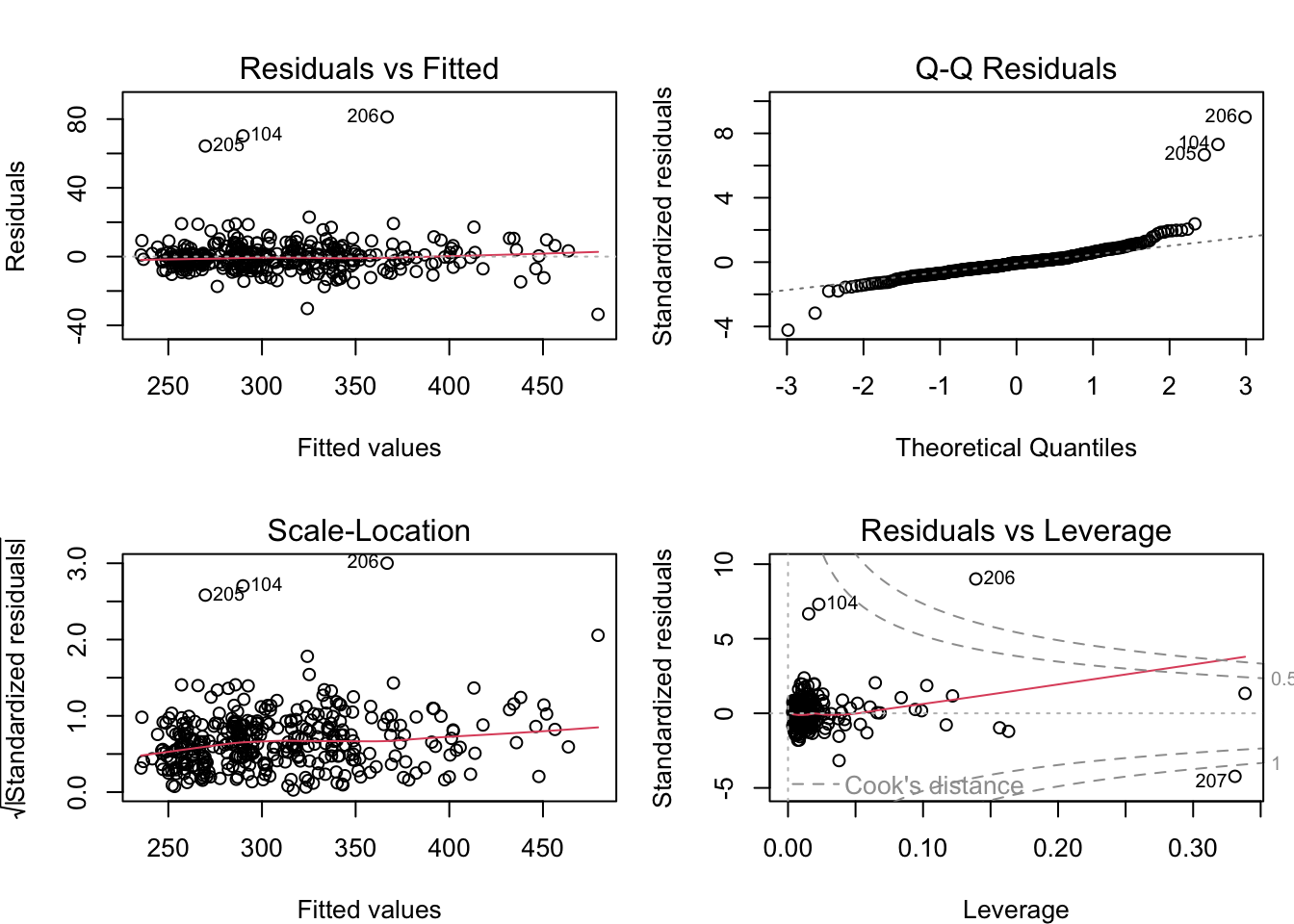
157.2.3 Step 3: Diagnostics

par(mfrow = c(2, 2), mar = c(4, 4, 3, 1))
plot(fit_specific)
par(mfrow = c(1, 1))
Figure 157.1: Residual diagnostics for the GtS dynamic regression
# Check residual autocorrelation
resid_gts <- residuals(fit_specific)
cat("Ljung-Box test on residuals:\n")
print(Box.test(resid_gts, lag = 24, type = "Ljung-Box"))
Ljung-Box test on residuals:

    Box-Ljung test

data:  resid_gts
X-squared = 13.055, df = 24, p-value = 0.9652

157.2.4 Comparison with the Transfer Function Model

# Compare AIC/BIC
cat("GtS dynamic regression AIC:", AIC(fit_specific), "\n")
cat("GtS dynamic regression BIC:", BIC(fit_specific), "\n")
cat("\nNumber of parameters in specific model:",
    length(coef(fit_specific)), "\n")
GtS dynamic regression AIC: 2622.612 
GtS dynamic regression BIC: 2649.697 

Number of parameters in specific model: 6 

The GtS dynamic regression and the transfer function model from Section 156.5 answer the same question — how does Colombia influence USA? — but use different parameterisations. The TF-noise model uses the \((r, s, b)\) structure identified from the CCF, while the GtS approach lets backward elimination determine which lags matter.

# Side-by-side out-of-sample comparison on the last 24 months
h <- 24
train_end <- n - h

# ---------- GtS one-step-ahead conditional predictions ----------
max_lag <- 6
start_idx <- max_lag + 1
df_all <- data.frame(y = usa[start_idx:n])
for (i in 1:max_lag) {
  df_all[[paste0("y_lag", i)]] <- usa[(start_idx - i):(n - i)]
}
for (j in 0:max_lag) {
  df_all[[paste0("x_lag", j)]] <- colombia[(start_idx - j):(n - j)]
}

train_rows <- 1:(train_end - max_lag)
test_rows <- (train_end - max_lag + 1):(n - max_lag)

fit_general_oos <- lm(y ~ ., data = df_all[train_rows, ])
fit_specific_oos <- step(fit_general_oos, direction = "backward", trace = 0)
pred_gts <- predict(fit_specific_oos, newdata = df_all[test_rows, ])
actual <- usa[(train_end + 1):n]

# ---------- Transfer function forecast ----------
xreg_lagged <- cbind(
  col_lag0 = as.numeric(colombia),
  col_lag1 = c(NA, as.numeric(colombia[-n])),
  col_lag2 = c(NA, NA, as.numeric(colombia[-c(n-1, n)])),
  col_lag3 = c(NA, NA, NA, as.numeric(colombia[-c(n-2, n-1, n)])),
  col_lag4 = c(NA, NA, NA, NA, as.numeric(colombia[-c(n-3, n-2, n-1, n)]))
)
tf_start <- 5
fit_tf_oos <- arima(usa[tf_start:train_end],
                    order = c(3, 1, 0),
                    xreg = xreg_lagged[tf_start:train_end, ])
fc_tf <- predict(fit_tf_oos, n.ahead = h,
                 newxreg = xreg_lagged[(train_end + 1):n, ])
pred_tf <- as.numeric(fc_tf$pred)

mae <- function(a, p) mean(abs(a - p), na.rm = TRUE)
rmse <- function(a, p) sqrt(mean((a - p)^2, na.rm = TRUE))

cmp <- data.frame(
  Model = c("GtS dynamic regression", "Transfer function (ARIMA+lagged xreg)"),
  MAE = c(mae(actual, pred_gts), mae(actual, pred_tf)),
  RMSE = c(rmse(actual, pred_gts), rmse(actual, pred_tf))
)
cat("Holdout comparison (last", h, "months):\n")
print(cmp, row.names = FALSE)
Holdout comparison (last 24 months):
                                 Model       MAE     RMSE
                GtS dynamic regression  9.552674 12.64849
 Transfer function (ARIMA+lagged xreg) 14.127852 18.29570

The table compares two non-identical forecasting setups on the same holdout. The GtS model uses one-step-ahead conditional predictions from selected lag regressors; the TF model uses multi-step ARIMA forecasts with lagged external inputs. The purpose is pedagogical: both approaches can be compared transparently on a common target series.

157.3 Error Correction Models (ECM)

157.3.1 Cointegration

When two time series \(X\) and \(Y\) are both non-stationary and integrated of the same order (typically \(I(1)\)), but an estimated linear combination \(Y_t - \\hat{\\beta} X_t\) is stationary (\(I(0)\)), the series are said to be cointegrated. Cointegration implies a long-run equilibrium relationship: the series may wander individually, but they do not drift apart without bound.

For the Coffee prices, cointegration would mean that Colombian import prices and US retail prices share a common long-run trend — which is economically plausible, as they reflect the same underlying commodity.

157.3.2 The Error Correction Model

If \(X\) and \(Y\) are cointegrated, the appropriate model is the Error Correction Model:

\[ \\Delta Y_t = \\text{short-run dynamics} + \\lambda_{ec} (Y_{t-1} - \\beta X_{t-1}) + e_t \]

The term \((Y_{t-1} - \\beta X_{t-1})\) is the error correction term: it measures how far the system is from its long-run equilibrium. The coefficient \(\\lambda_{ec}\) (typically negative) controls the speed of adjustment back to equilibrium.

157.3.3 Engle-Granger Two-Step Procedure

The Engle-Granger procedure tests for cointegration and estimates the ECM:

Step 1: Estimate the long-run relationship \(Y_t = \beta_0 + \beta_1 X_t + u_t\) by OLS.

Step 2: Test the residuals \(\hat{u}_t\) for stationarity using an augmented Dickey-Fuller (ADF) regression (Dickey and Fuller 1979) (with lagged differences). If the residuals are stationary, the series are cointegrated.

Step 3: If cointegrated, estimate the ECM using the lagged residuals as the error correction term.

library(lmtest)
library(urca)

coffee <- read.csv("coffee.csv")
colombia <- ts(coffee$Colombia, frequency = 12)
usa <- ts(coffee$USA, frequency = 12)

# Step 1: Long-run relationship
fit_lr <- lm(usa ~ colombia)
cat("Long-run relationship:\n")
cat("  USA =", round(coef(fit_lr)[1], 2), "+",
    round(coef(fit_lr)[2], 2), "* Colombia\n\n")

# Step 2: Test residuals for stationarity (ADF test)
resid_lr <- residuals(fit_lr)

# Residual-based ADF with lag augmentation (lag length selected by AIC)
eg_adf <- ur.df(resid_lr, type = "none", lags = 12, selectlags = "AIC")
cat("Residual-based ADF (Engle-Granger step 2):\n")
print(summary(eg_adf))

# Optional robustness cross-check: Phillips-Ouliaris cointegration test
po_test <- ca.po(cbind(usa, colombia), demean = "constant", type = "Pu")
cat("\nPhillips-Ouliaris cointegration test:\n")
print(summary(po_test))

# Step 3: ECM estimation (if cointegrated)
dy <- diff(as.numeric(usa))
dx <- diff(as.numeric(colombia))
ect_lag <- resid_lr[-length(resid_lr)]  # lagged equilibrium error

fit_ecm <- lm(dy ~ dx + ect_lag)
cat("Error Correction Model:\n")
print(summary(fit_ecm))
Long-run relationship:
  USA = 165.55 + 1.84 * Colombia

Residual-based ADF (Engle-Granger step 2):

############################################### 
# Augmented Dickey-Fuller Test Unit Root Test # 
############################################### 

Test regression none 


Call:
lm(formula = z.diff ~ z.lag.1 - 1 + z.diff.lag)

Residuals:
    Min      1Q  Median      3Q     Max 
-61.114  -5.955  -1.766   4.385  66.058 

Coefficients:
            Estimate Std. Error t value Pr(>|t|)   
z.lag.1     -0.07616    0.02346  -3.247  0.00128 **
z.diff.lag1  0.16321    0.05454   2.993  0.00297 **
z.diff.lag2 -0.10504    0.05413  -1.940  0.05315 . 
z.diff.lag3  0.10396    0.05433   1.914  0.05649 . 
z.diff.lag4 -0.13564    0.05378  -2.522  0.01212 * 
z.diff.lag5 -0.09799    0.05406  -1.813  0.07078 . 
---
Signif. codes:  0 '***' 0.001 '**' 0.01 '*' 0.05 '.' 0.1 ' ' 1

Residual standard error: 13.3 on 341 degrees of freedom
Multiple R-squared:  0.1094,    Adjusted R-squared:  0.09369 
F-statistic: 6.978 on 6 and 341 DF,  p-value: 5.165e-07


Value of test-statistic is: -3.2471 

Critical values for test statistics: 
      1pct  5pct 10pct
tau1 -2.58 -1.95 -1.62


Phillips-Ouliaris cointegration test:

######################################## 
# Phillips and Ouliaris Unit Root Test # 
######################################## 

Test of type Pu 
detrending of series with constant only 


Call:
lm(formula = z[, 1] ~ z[, -1])

Residuals:
    Min      1Q  Median      3Q     Max 
-104.10  -23.01   -1.58   28.30  106.62 

Coefficients:
             Estimate Std. Error t value Pr(>|t|)    
(Intercept) 165.55010    7.74054   21.39   <2e-16 ***
z[, -1]       1.84168    0.09701   18.98   <2e-16 ***
---
Signif. codes:  0 '***' 0.001 '**' 0.01 '*' 0.05 '.' 0.1 ' ' 1

Residual standard error: 34.65 on 358 degrees of freedom
Multiple R-squared:  0.5017,    Adjusted R-squared:  0.5003 
F-statistic: 360.4 on 1 and 358 DF,  p-value: < 2.2e-16


Value of test-statistic is: 66.5564 

Critical values of Pu are:
                  10pct   5pct    1pct
critical values 27.8536 33.713 48.0021

Error Correction Model:

Call:
lm(formula = dy ~ dx + ect_lag)

Residuals:
    Min      1Q  Median      3Q     Max 
-18.890  -5.370  -1.906   2.351 108.912 

Coefficients:
            Estimate Std. Error t value Pr(>|t|)    
(Intercept)  0.15140    0.59816   0.253 0.800330    
dx           0.37066    0.11025   3.362 0.000858 ***
ect_lag     -0.08426    0.01732  -4.864 1.73e-06 ***
---
Signif. codes:  0 '***' 0.001 '**' 0.01 '*' 0.05 '.' 0.1 ' ' 1

Residual standard error: 11.33 on 356 degrees of freedom
Multiple R-squared:  0.08827,   Adjusted R-squared:  0.08314 
F-statistic: 17.23 on 2 and 356 DF,  p-value: 7.188e-08

For the residual-based unit-root step, use the reported ADF critical values (or p-values), not standard \(t\)-test cutoffs. If the residual null of a unit root is rejected, cointegration is supported and the ECM is appropriate. The code above also computes the Phillips-Ouliaris (Phillips and Ouliaris 1990) residual-based cointegration test as an independent cross-check.

The coefficient of the error-correction term (\(\\hat{\\lambda}_{ec}\)) indicates adjustment speed. For example, \(\\hat{\\lambda}_{ec}=-0.10\) means roughly 10% of disequilibrium is corrected per period, while \(\\hat{\\lambda}_{ec}=-0.40\) indicates substantially faster adjustment. A significant negative coefficient is the expected sign in a stable ECM.

157.4 The Family Tree of Dynamic Models

The models covered in this part of the handbook form a coherent family, all sharing the Box-Jenkins foundation of separating systematic dynamics from noise and testing residuals for white noise.

Box-Jenkins (1970)
├── Univariate ARIMA
│   ├── Identification (ACF/PACF) ──── Ch. @sec-identifying-arma-parameters
│   ├── Estimation (backward sel.) ─── Ch. @sec-estimating-arma-parameters-and-residual-diagnostics
│   └── Forecasting ────────────────── Ch. @sec-forecasting-with-arima-models
│
├── Intervention Analysis ──────────── Ch. @sec-intervention-analysis
│   └── Binary inputs (pulse, step)
│
└── Transfer Function Noise ────────── Ch. @sec-transfer-function-noise
    └── Continuous inputs with lags
        │
        ├── Special case: ARIMAX (no lag dynamics)
        │
        └── Extensions:
            ├── Dynamic Regression / GtS ── This chapter
            ├── ECM / VECM (Engle-Granger, 1987; Johansen, 1988)
            ├── VAR (Sims, 1980) ── multiple equations
            ├── State-space (Harvey, Kalman) ── time-varying parameters
            └── Auto-ARIMA (Hyndman) ── automated identification

All of these models share a common diagnostic principle: if the residuals are not white noise, the model is missing something. The differences lie in how the systematic component is specified.

Note

The tsplot app (shiny.wessa.net/tsplot/) offers Prophet forecasts alongside ARIMA — a fundamentally different paradigm based on additive decomposition (trend + seasonality + holidays) rather than the stochastic difference equations of Box-Jenkins. The two paradigms answer the same forecasting question but make very different assumptions about the data-generating process.

157.5 What This Handbook Does Not (Yet) Cover

The models presented in this handbook cover the core Box-Jenkins framework and its most important extensions. Several natural follow-up topics are left for future editions:

  • VAR / VECM: Vector autoregressive models for systems of multiple time series, where each series depends on its own lags and the lags of all other series (Sims 1980)
  • State-space / structural time series models: Models where the parameters (trend, seasonal) are allowed to evolve over time (Harvey 1989)
  • GARCH / volatility models: Models for time-varying variance (Engle 1982; Bollerslev 1986) — important in finance
  • Machine learning approaches: Neural networks, gradient boosting, and other non-parametric methods applied to time series forecasting

These are all active areas of research and practice, and they build naturally on the foundation laid in this handbook.

157.6 Tasks

  1. Apply the GtS approach to the Unemployment series with the financial crisis step dummy (from Section 154.6). Start with 6 AR lags and the step variable, then simplify. Compare the resulting model with the intervention ARIMA from Section 154.6.

  2. Test for cointegration between Colombian and US coffee prices using the Engle-Granger procedure. If the series are cointegrated, estimate an ECM and interpret the speed of adjustment parameter.

  3. Compare forecast accuracy for the last 24 months of USA retail coffee prices using four models: (a) pure ARIMA, (b) ARIMAX, (c) transfer function with lags, and (d) GtS dynamic regression. Which performs best on MAE and RMSE? Why might the results differ?

Akaike, Hirotugu. 1974. “A New Look at the Statistical Model Identification.” IEEE Transactions on Automatic Control 19 (6): 716–23. https://doi.org/10.1109/TAC.1974.1100705.
Bollerslev, Tim. 1986. “Generalized Autoregressive Conditional Heteroskedasticity.” Journal of Econometrics 31 (3): 307–27. https://doi.org/10.1016/0304-4076(86)90063-1.
Dickey, David A., and Wayne A. Fuller. 1979. “Distribution of the Estimators for Autoregressive Time Series with a Unit Root.” Journal of the American Statistical Association 74 (366): 427–31. https://doi.org/10.1080/01621459.1979.10482531.
Engle, Robert F. 1982. “Autoregressive Conditional Heteroscedasticity with Estimates of the Variance of United Kingdom Inflation.” Econometrica 50 (4): 987–1007. https://doi.org/10.2307/1912773.
Engle, Robert F., and Clive W. J. Granger. 1987. “Co-Integration and Error Correction: Representation, Estimation, and Testing.” Econometrica 55 (2): 251–76. https://doi.org/10.2307/1913236.
Harvey, Andrew C. 1989. Forecasting, Structural Time Series Models and the Kalman Filter. Cambridge: Cambridge University Press. https://doi.org/10.1017/CBO9781107049994.
Hendry, David F. 1995. Dynamic Econometrics. Oxford: Oxford University Press.
Johansen, Søren. 1988. “Statistical Analysis of Cointegration Vectors.” Journal of Economic Dynamics and Control 12 (2–3): 231–54. https://doi.org/10.1016/0165-1889(88)90041-3.
Phillips, Peter C. B., and Sam Ouliaris. 1990. “Asymptotic Properties of Residual Based Tests for Cointegration.” Econometrica 58 (1): 165–93. https://doi.org/10.2307/2938339.
Sims, Christopher A. 1980. “Macroeconomics and Reality.” Econometrica 48 (1): 1–48. https://doi.org/10.2307/1912017.
156  Transfer Function Noise Models
Model Building Strategies

© 2026 Patrick Wessa. Provided as-is, without warranty.

Feedback: e-mail | Anonymous contributions: click to copy (Sats) | click to copy (XMR)

Cookie Preferences