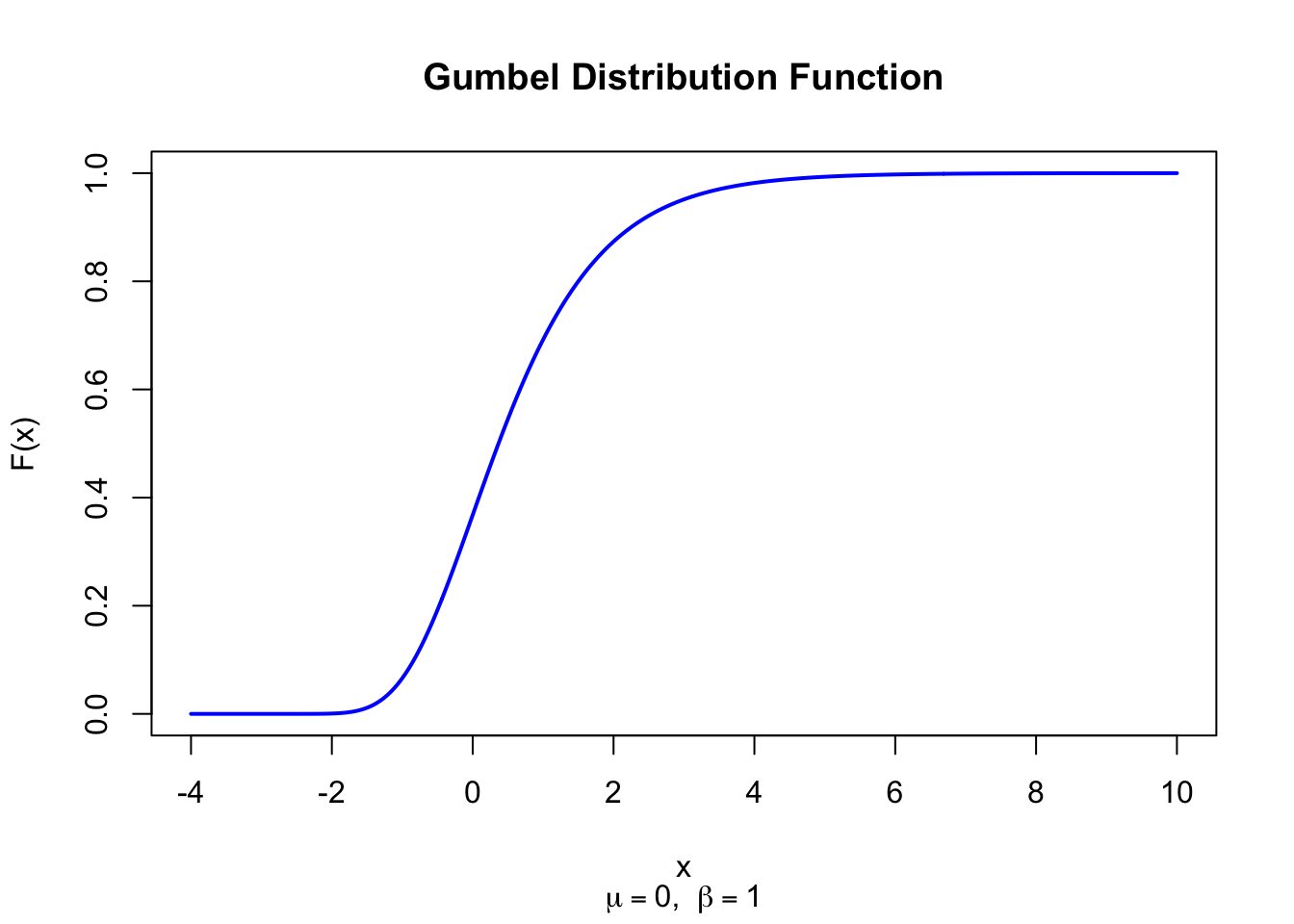
The Gumbel distribution is the limiting distribution of the maximum of many independent random variables from light-tailed distributions. It is the cornerstone of extreme-value statistics, used wherever one needs to model the probability of record-breaking events: annual flood peaks, maximum daily temperatures, or largest structural loads.
Formally, the random variate \(X\) defined for all of \(\mathbb{R}\), is said to have a Gumbel Distribution (i.e. \(X \sim \text{Gumbel}(\mu, \beta)\)) with location parameter \(\mu \in \mathbb{R}\) and scale parameter \(\beta > 0\). The Euler-Mascheroni constant is \(\gamma \approx 0.5772156649\).
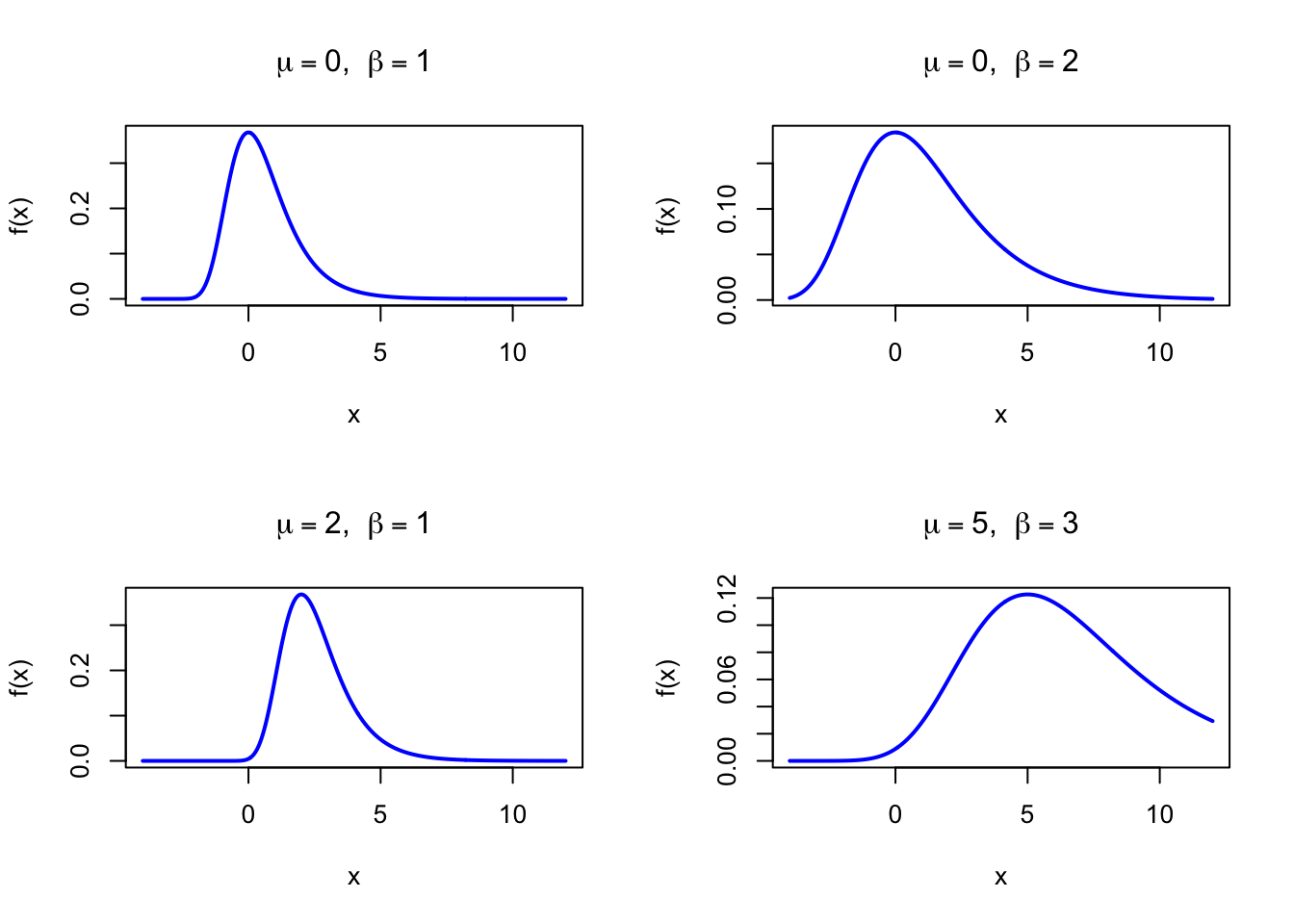
The figure below shows examples of the Gumbel Probability Density Function for different parameter combinations.
Code
dgumbel <-function(x, mu, beta) { z <- (x - mu) / betaexp(-z -exp(-z)) / beta}par(mfrow =c(2, 2))x <-seq(-4, 12, length =500)plot(x, dgumbel(x, 0, 1), type ="l", lwd =2, col ="blue",xlab ="x", ylab ="f(x)", main =expression(paste(mu ==0, ", ", beta ==1)))plot(x, dgumbel(x, 0, 2), type ="l", lwd =2, col ="blue",xlab ="x", ylab ="f(x)", main =expression(paste(mu ==0, ", ", beta ==2)))plot(x, dgumbel(x, 2, 1), type ="l", lwd =2, col ="blue",xlab ="x", ylab ="f(x)", main =expression(paste(mu ==2, ", ", beta ==1)))plot(x, dgumbel(x, 5, 3), type ="l", lwd =2, col ="blue",xlab ="x", ylab ="f(x)", main =expression(paste(mu ==5, ", ", beta ==3)))par(mfrow =c(1, 1))
Figure 38.1: Gumbel Probability Density Function for various parameter combinations
38.2 Purpose
The Gumbel distribution belongs to the generalized extreme value (GEV) family and specifically describes the limiting distribution of block maxima from distributions with exponentially bounded tails (Normal, Exponential, Gamma). Its right-skewed shape with a mode below the mean is characteristic of maximum-type data. Common applications include:
Hydrology: annual maximum flood discharge, maximum daily rainfall
Structural engineering: maximum wind load, maximum snow depth for design standards
Climatology: maximum daily temperature records, extreme precipitation events
Financial risk: maximum portfolio loss within a given time horizon
Reliability engineering: maximum stress or load applied to a component
Relation to the discrete setting. The Gumbel distribution is the continuous limit of the maximum of \(n\) i.i.d. Geometric or Poisson variates after normalization — the Fisher-Tippett-Gnedenko theorem applies in the discrete domain too. For the maximum of Geometric\((p)\) variates as \(n\to\infty\), the normalized maximum approaches a Gumbel distribution.
Annual maximum wind gust speeds (m/s) at a weather station are modeled as \(X \sim \text{Gumbel}(\mu = 10, \beta = 5)\). We compute the probability that the annual maximum gust exceeds 18 m/s.
The Gumbel distribution is one of only three possible limiting distributions for normalized block maxima (Fisher-Tippett-Gnedenko theorem). It arises from distributions with exponentially bounded tails (Normal, Gamma, Exponential, Lognormal). This is the continuous-data counterpart of the classical central limit theorem for extreme values.
38.23 Property 2: Universal Shape Constants
Both the skewness \(g_1 \approx 1.1395\) and kurtosis \(g_2 = 5.4\) are universal constants — they do not depend on \(\mu\) or \(\beta\). Any data with these shape properties is consistent with the Gumbel model.
38.24 Property 3: Relationship to Weibull via Minimum
If \(X \sim \text{Gumbel}(\mu, \beta)\) then \(-X\) follows the minimum (reversed) Gumbel distribution. Furthermore, if \(Y = e^{-X/\beta}\) then \(Y\) follows a Weibull distribution, linking the two extreme-value families.
38.25 Related Distributions 1: Weibull Distribution
The Weibull distribution is related to the Gumbel via a log-transformation: if \(X \sim \text{Weibull}(k, \lambda)\) then \(\ln\!\left((X/\lambda)^k\right)\) follows the minimum Gumbel, while \(-\ln\!\left((X/\lambda)^k\right)\) follows the maximum Gumbel (see Chapter 31).
38.26 Related Distributions 2: Exponential Distribution
The Exponential distribution belongs to the Gumbel domain of attraction: the normalized maximum of \(n\) i.i.d. Exp\((\lambda)\) variates converges to Gumbel as \(n \to \infty\) (see Chapter 27).
38.27 Related Distributions 3: GEV Distribution
The Gumbel distribution is the special case of the Generalized Extreme Value distribution with shape parameter \(\xi = 0\): \(\text{GEV}(\mu, \sigma, 0) = \text{Gumbel}(\mu, \sigma)\). The GEV family unifies the Gumbel (Type I), Fréchet (Type II, \(\xi > 0\)), and reversed Weibull (Type III, \(\xi < 0\)) extreme-value distributions (see Chapter 45).