The Inverse Gamma distribution is the distribution of the reciprocal of a Gamma random variable. In Bayesian statistics it is the standard conjugate prior for the variance \(\sigma^2\) of a Normal distribution, and it arises whenever one models precision or scale uncertainty.
Formally, the random variate \(X\) defined for the range \(X > 0\), is said to have an Inverse Gamma Distribution (i.e. \(X \sim \text{InvGamma}(\alpha, \beta)\)) with shape parameter \(\alpha > 0\) and scale parameter \(\beta > 0\). If \(Y \sim \text{Gamma}(\alpha, \beta)\) then \(X = 1/Y \sim \text{InvGamma}(\alpha, \beta)\).
33.1 Probability Density Function
\[
f(x) = \frac{\beta^\alpha}{\Gamma(\alpha)}\,x^{-\alpha-1}\exp(-\beta/x), \quad x > 0
\]
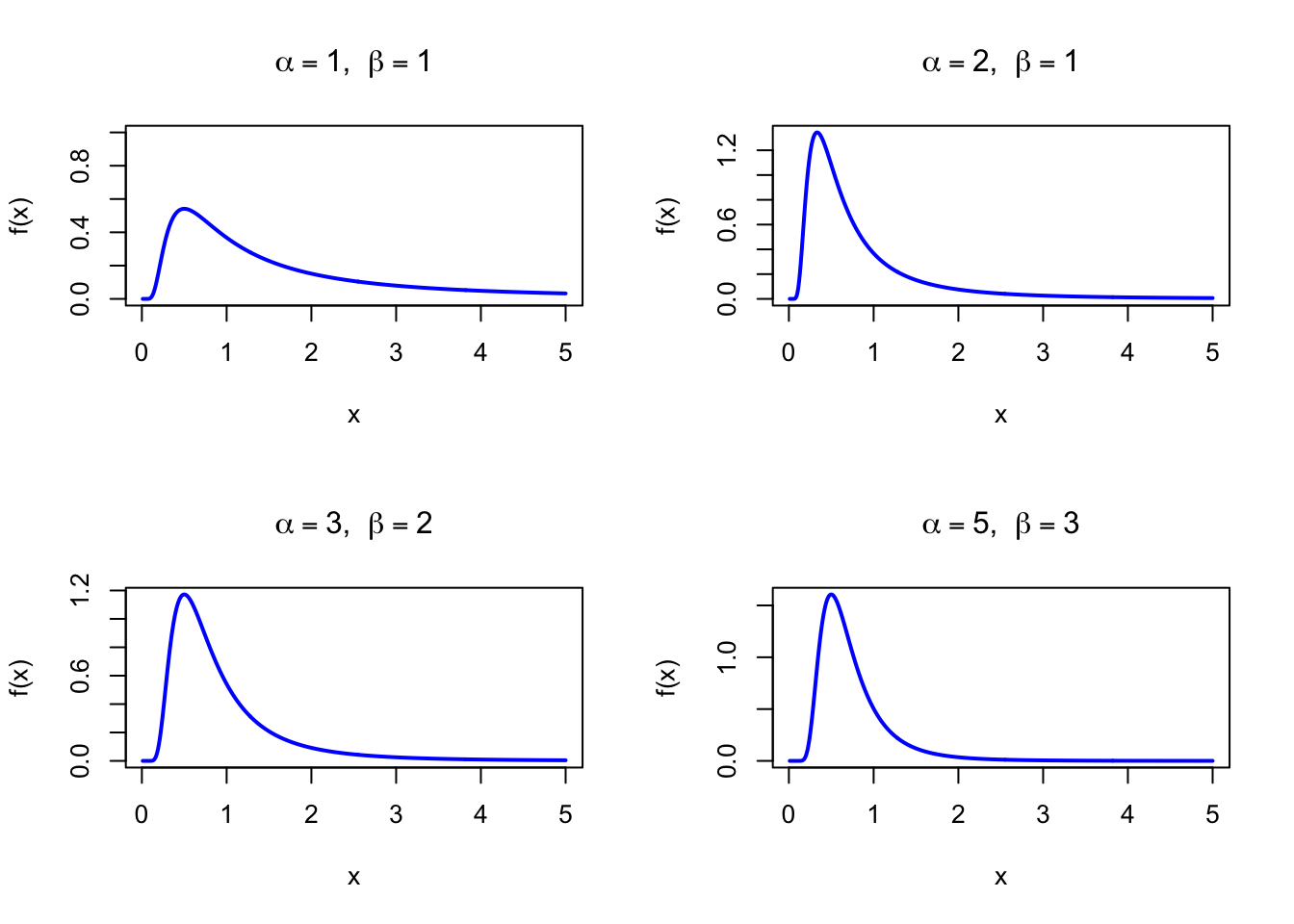
The figure below shows examples of the Inverse Gamma Probability Density Function for different parameter combinations.
Code
dinvgamma <-function(x, alpha, beta) {ifelse(x >0, beta^alpha /gamma(alpha) * x^(-alpha -1) *exp(-beta / x), 0)}par(mfrow =c(2, 2))x <-seq(0.01, 5, length =500)plot(x, dinvgamma(x, 1, 1), type ="l", lwd =2, col ="blue",xlab ="x", ylab ="f(x)", main =expression(paste(alpha ==1, ", ", beta ==1)),ylim =c(0, 1))plot(x, dinvgamma(x, 2, 1), type ="l", lwd =2, col ="blue",xlab ="x", ylab ="f(x)", main =expression(paste(alpha ==2, ", ", beta ==1)))plot(x, dinvgamma(x, 3, 2), type ="l", lwd =2, col ="blue",xlab ="x", ylab ="f(x)", main =expression(paste(alpha ==3, ", ", beta ==2)))plot(x, dinvgamma(x, 5, 3), type ="l", lwd =2, col ="blue",xlab ="x", ylab ="f(x)", main =expression(paste(alpha ==5, ", ", beta ==3)))par(mfrow =c(1, 1))
Figure 33.1: Inverse Gamma Probability Density Function for various parameter combinations
33.2 Purpose
The Inverse Gamma distribution arises naturally as the reciprocal of a Gamma random variable and plays a central role in Bayesian hierarchical modeling. Its most important application is as a conjugate prior for the variance parameter of a Normal likelihood. Common applications include:
Bayesian prior for the variance \(\sigma^2\) in Normal-Normal models (conjugate prior)
Posterior distribution of variance after observing Gaussian data
Modeling scale or spread parameters that must be positive
Scale-inverse-chi-squared distribution (reparameterized Inverse Gamma) in objective Bayes
Mixing distribution in hierarchical models (e.g., Student’s t as Normal-Inverse-Gamma mixture)
Relation to the discrete setting. The Inverse Gamma has no direct discrete analog. Conceptually, it mirrors the Negative Binomial as a mixing distribution: just as a Poisson-Gamma mixture yields the Negative Binomial for counts, an analogous continuous hierarchy uses the Inverse Gamma to model scale uncertainty.
33.3 Distribution Function
\[
F(x) = \frac{\Gamma(\alpha,\,\beta/x)}{\Gamma(\alpha)}, \quad x > 0
\]
where \(\Gamma(\alpha, z) = \int_z^\infty t^{\alpha-1} e^{-t}\, dt\) is the upper incomplete gamma function. In R: pgamma(1/x, shape = alpha, rate = beta, lower.tail = FALSE) (note: Gamma rate = beta matches the InvGamma scale parameter \(\beta\)).
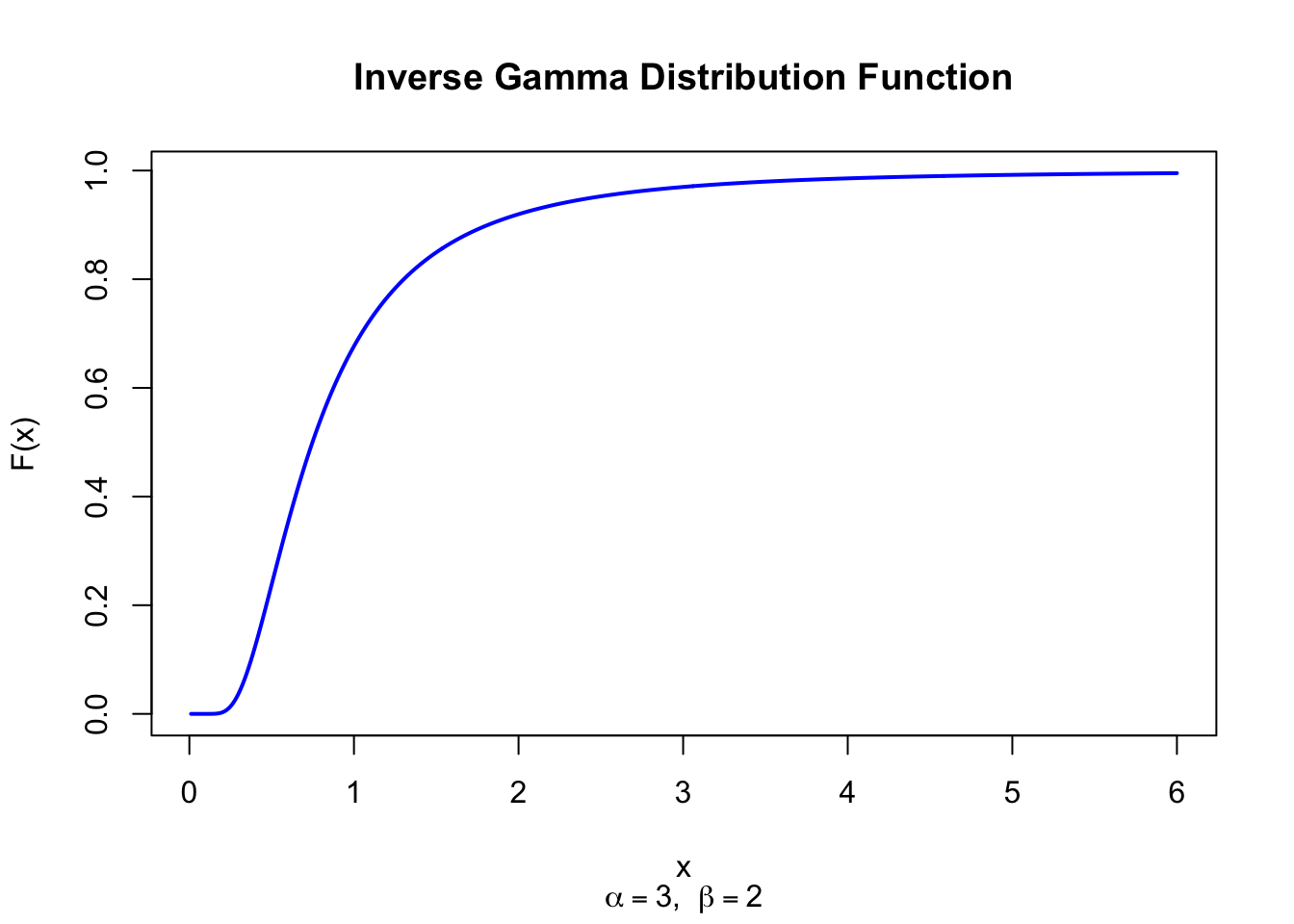
The figure below shows the Inverse Gamma Distribution Function for \(\alpha = 3\) and \(\beta = 2\).
Code
pinvgamma <-function(x, alpha, beta) {pgamma(1/x, shape = alpha, rate = beta, lower.tail =FALSE)}x <-seq(0.01, 6, length =500)plot(x, pinvgamma(x, 3, 2), type ="l", lwd =2, col ="blue",xlab ="x", ylab ="F(x)", main ="Inverse Gamma Distribution Function",sub =expression(paste(alpha ==3, ", ", beta ==2)))
Figure 33.2: Inverse Gamma Distribution Function (alpha = 3, beta = 2)
33.4 Moment Generating Function
The moment generating function of the Inverse Gamma distribution does not exist for \(t > 0\).
The following code demonstrates Inverse Gamma probability calculations:
alpha <-3; beta <-2# Custom density functiondinvgamma <-function(x, alpha, beta) {ifelse(x >0, beta^alpha /gamma(alpha) * x^(-alpha -1) *exp(-beta / x), 0)}# Custom CDF using pgammapinvgamma <-function(x, alpha, beta) {pgamma(1/x, shape = alpha, rate = beta, lower.tail =FALSE)}# Density at x = 1dinvgamma(1, alpha, beta)# P(X <= 1): distribution functionpinvgamma(1, alpha, beta)# Mode and meancat("Mode:", beta / (alpha +1), "\n")cat("Mean:", beta / (alpha -1), "\n")
[1] 0.5413411
[1] 0.6766764
Mode: 0.5
Mean: 1
33.20 Example
A Bayesian analysis uses \(\text{InvGamma}(3, 2)\) as a prior for the variance \(\sigma^2\) of a Normal likelihood. The mode is \(\beta/(\alpha+1) = 2/4 = 0.5\) and the mean is \(\beta/(\alpha-1) = 2/2 = 1\).
33.22 Property 1: Reciprocal Relationship with Gamma
If \(Y \sim \text{Gamma}(\alpha, \beta)\) then \(1/Y \sim \text{InvGamma}(\alpha, \beta)\). See Chapter 29.
33.23 Property 2: Conjugate Prior for Normal Variance
If \(X_1, \ldots, X_n \overset{\text{i.i.d.}}{\sim} N(\mu, \sigma^2)\) with known mean \(\mu\) and \(\sigma^2 \sim \text{InvGamma}(\alpha, \beta)\), then:
If \(\mu\) is unknown, the conjugate prior is joint Normal-Inverse-Gamma rather than an Inverse Gamma prior on \(\sigma^2\) alone; in that case the variance update involves the centered sum of squares around \(\bar{x}\) and the shape update changes accordingly.
33.24 Property 3: Scale-Inverse-Chi-Squared
The scale-inverse-chi-squared distribution is a reparameterization of the Inverse Gamma:
The Gamma distribution is the distribution of \(1/X\) when \(X \sim \text{InvGamma}(\alpha, \beta)\) (see Chapter 29).
33.26 Related Distributions 2: Chi-Squared Distribution
\(\chi^2(\nu) = \text{Gamma}(\nu/2, 1/2)\), so \(1/\chi^2(\nu) \propto \text{InvGamma}(\nu/2, 1/2)\) — forming the basis of the inverse-chi-squared distribution used in Bayesian variance inference (see Chapter 23).
33.27 Related Distributions 3: Inverse Chi-Squared Distribution
The Inverse Chi-squared distribution is a special case of the Inverse Gamma: \(\text{InvChi}^2(\nu) = \text{InvGamma}(\nu/2, 1/2)\). The scaled variant \(\text{Scale-InvChi}^2(\nu, \sigma_0^2) = \text{InvGamma}(\nu/2, \nu\sigma_0^2/2)\) serves as the conjugate prior for the Normal variance in Bayesian inference (see Chapter 49).