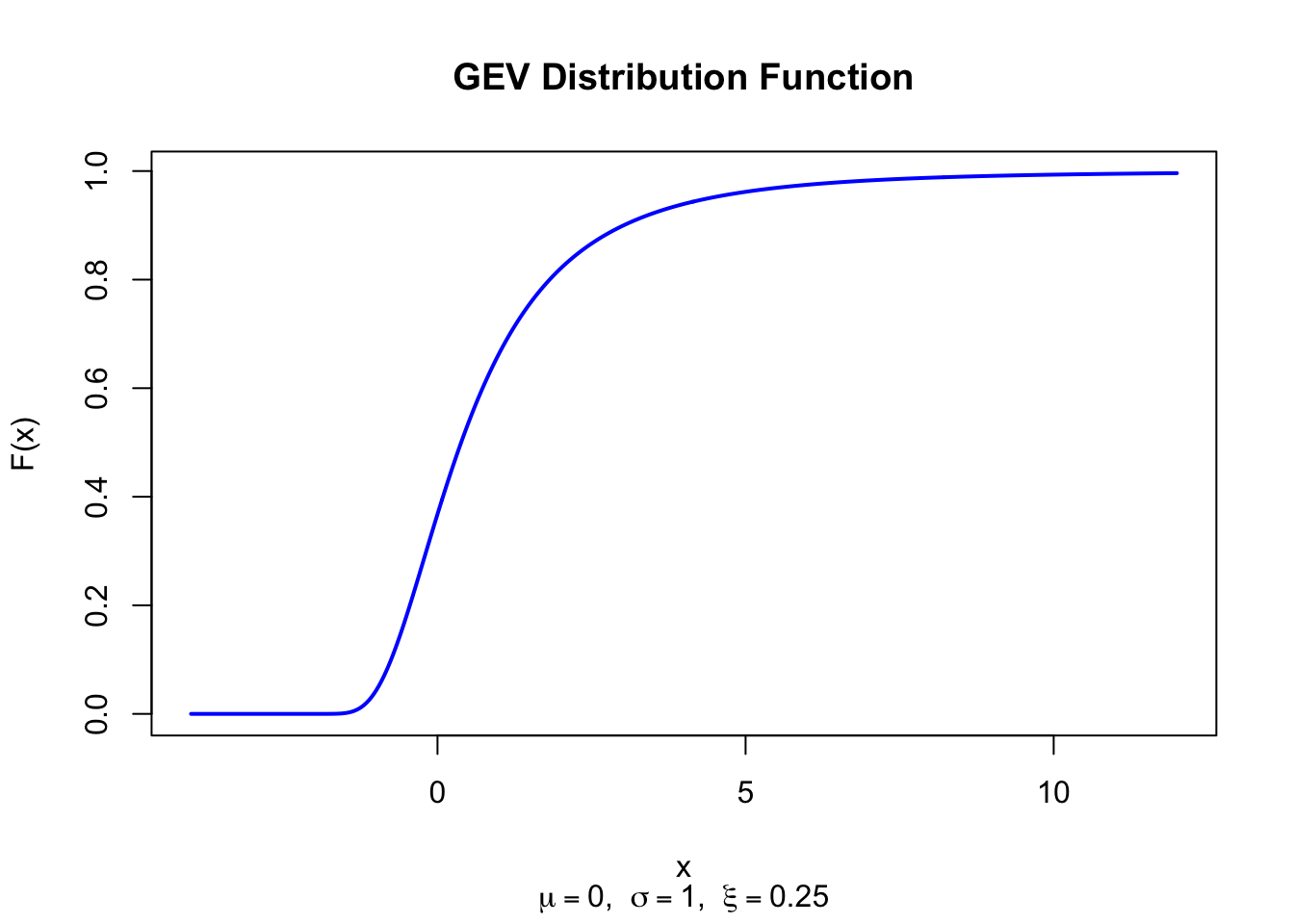
The Generalized Extreme Value distribution is the universal limiting distribution for block maxima of i.i.d. random variables. By the Fisher-Tippett-Gnedenko theorem, any properly normalized sequence of block maxima that converges in distribution must converge to a GEV — making it the single most important model in extreme-value statistics.
Formally, the random variate \(X\) is said to have a Generalized Extreme Value Distribution (i.e. \(X \sim \text{GEV}(\mu, \sigma, \xi)\)) with location parameter \(\mu \in \mathbb{R}\), scale parameter \(\sigma > 0\), and shape parameter \(\xi \in \mathbb{R}\). The shape parameter \(\xi\) determines the tail behavior and unifies three classical extreme-value types: the Gumbel (\(\xi = 0\)), the Frechet (\(\xi > 0\)), and the reversed Weibull (\(\xi < 0\)). We define \(z = (x - \mu)/\sigma\) throughout this chapter.
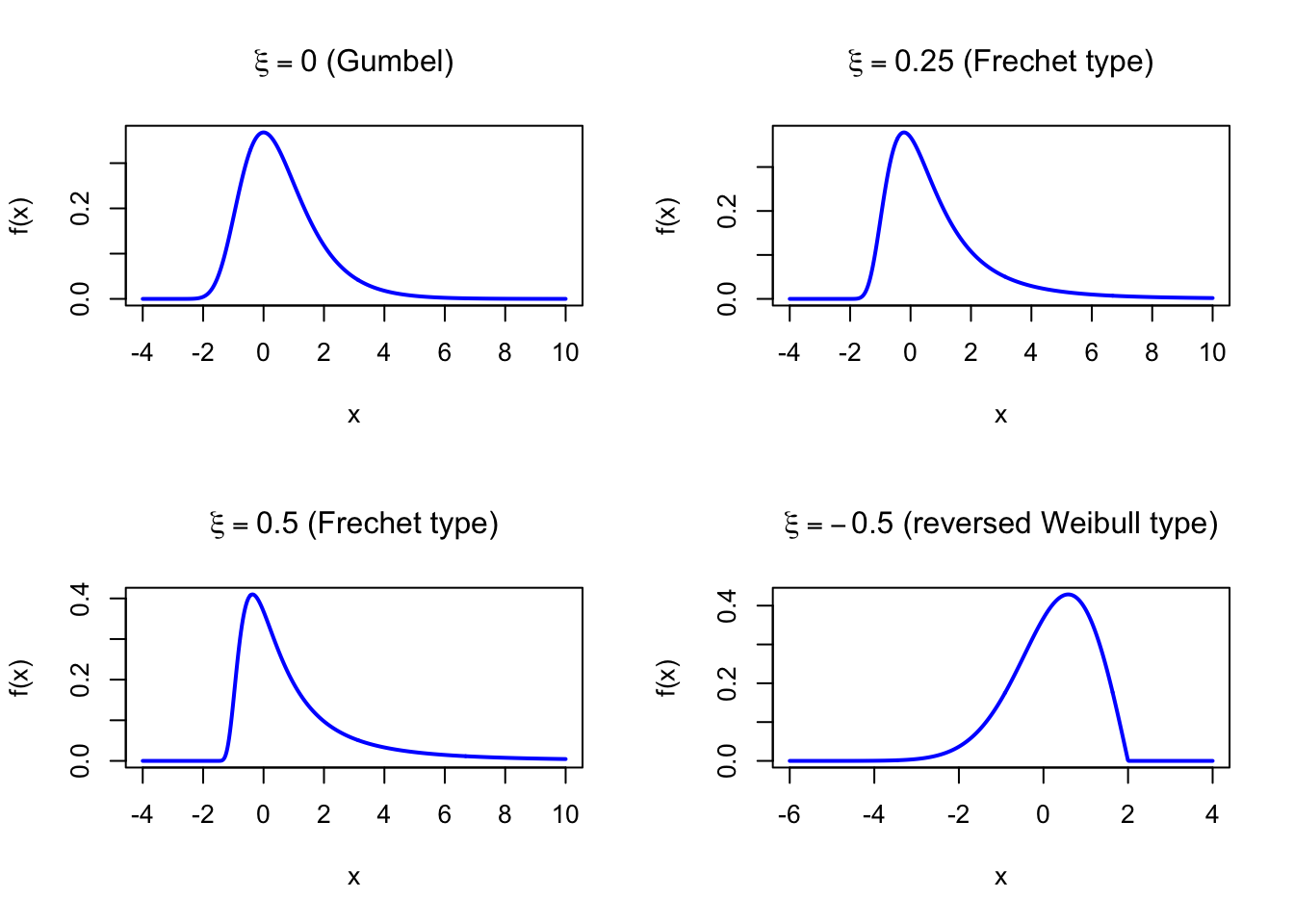
The figure below shows examples of the GEV Probability Density Function for different shape parameter values with \(\mu = 0\) and \(\sigma = 1\).
Code
dgev_custom <-function(x, mu, sigma, xi) { z <- (x - mu) / sigmaif (abs(xi) <1e-8) {return(exp(-z -exp(-z)) / sigma) } t <-1+ xi * z valid <- t >0 d <-rep(0, length(x)) d[valid] <- (1/sigma) * t[valid]^(-1/xi -1) *exp(-t[valid]^(-1/xi)) d}par(mfrow =c(2, 2))x <-seq(-4, 10, length =500)plot(x, dgev_custom(x, 0, 1, 0), type ="l", lwd =2, col ="blue",xlab ="x", ylab ="f(x)", main =expression(paste(xi ==0, " (Gumbel)")))plot(x, dgev_custom(x, 0, 1, 0.25), type ="l", lwd =2, col ="blue",xlab ="x", ylab ="f(x)", main =expression(paste(xi ==0.25, " (Frechet type)")))plot(x, dgev_custom(x, 0, 1, 0.5), type ="l", lwd =2, col ="blue",xlab ="x", ylab ="f(x)", main =expression(paste(xi ==0.5, " (Frechet type)")))x2 <-seq(-6, 4, length =500)plot(x2, dgev_custom(x2, 0, 1, -0.5), type ="l", lwd =2, col ="blue",xlab ="x", ylab ="f(x)", main =expression(paste(xi ==-0.5, " (reversed Weibull type)")))par(mfrow =c(1, 1))
Figure 45.1: GEV Probability Density Function for various shape parameters (location = 0, scale = 1)
45.2 Purpose
The GEV distribution provides a unified framework for extreme-value modeling. Instead of choosing among three separate extreme-value distributions, the analyst fits a single GEV and lets the data determine \(\xi\) — thereby identifying whether the underlying parent has a light tail (\(\xi = 0\), Gumbel), a heavy tail (\(\xi > 0\), Frechet), or a bounded upper tail (\(\xi < 0\), reversed Weibull). Common applications include:
Flood risk analysis: annual maximum river discharge for dam design
Extreme temperature modeling: maximum daily temperatures for climate projections
Financial tail risk: extreme portfolio losses and Value-at-Risk estimation
Wind speed engineering: maximum wind gusts for structural design codes
Insurance catastrophe modeling: annual maximum claim sizes
Relation to the discrete setting. The GEV distribution is the continuous limit of the maximum of \(n\) i.i.d. random variables after normalization. There is no single discrete analog, but the Fisher-Tippett-Gnedenko theorem applies to discrete parents as well — the normalized maximum of Geometric, Poisson, or other discrete variates also converges to a GEV after appropriate centering and scaling.
For \(\xi = 0\) (Gumbel): \(g_1 \approx 1.1395\). For \(\xi > 0\) (Frechet type), the skewness increases as \(\xi\) increases. For \(\xi < 0\) (reversed Weibull type), the skewness decreases.
Annual maximum river discharge (m/s) at a gauging station is modeled as \(X \sim \text{GEV}(\mu = 500, \sigma = 100, \xi = 0.2)\). The positive shape parameter indicates heavy-tailed flood behavior (Frechet type). We compute the probability of exceeding a critical discharge threshold and the 100-year return level.
GEV random variates are generated via the inverse-CDF (quantile) method. Since \(F(x) = \exp\!\bigl(-(1 + \xi z)^{-1/\xi}\bigr)\), solving \(U = F(X)\) for \(X\) gives:
The GEV distribution is the only possible non-degenerate limiting distribution for properly normalized block maxima. If \(M_n = \max(X_1, \ldots, X_n)\) for i.i.d. random variables and there exist normalizing sequences \(a_n > 0\) and \(b_n\) such that \((M_n - b_n)/a_n\) converges in distribution to a non-degenerate limit, then that limit must be a GEV distribution for some \(\xi\).
45.23 Property 2: Three Types Unified
The shape parameter \(\xi\) determines the extreme-value type:
\(\xi < 0\): Reversed Weibull (Type III) — bounded upper tail (Uniform, Beta). This is the extreme-value family for maxima, not the standard Weibull lifetime distribution.
45.24 Property 3: Max-Stability
The GEV is max-stable: if \(X_1, \ldots, X_n\) are i.i.d. GEV\((\mu, \sigma, \xi)\), then \(\max(X_1, \ldots, X_n)\) is also GEV with the same shape \(\xi\) but updated location and scale:
This is the primary quantity of interest in flood frequency analysis, structural wind design, and insurance pricing.
45.26 Related Distributions 1: Gumbel Distribution
The Gumbel distribution is the special case \(\xi = 0\) of the GEV, arising as the limit for light-tailed parent distributions (see Chapter 38).
45.27 Related Distributions 2: Frechet Distribution
The Frechet distribution corresponds to \(\xi > 0\) in the GEV parameterization, arising as the limit for heavy-tailed parent distributions (see Chapter 46).
45.28 Related Distributions 3: Reversed Weibull Family
The reversed Weibull distribution (for maxima) corresponds to \(\xi < 0\) in the GEV, arising from parent distributions with a finite upper endpoint. It is part of extreme-value theory and should not be conflated with the standard Weibull lifetime distribution discussed elsewhere in the handbook.
45.29 Related Distributions 4: Exponential Distribution
The Exponential distribution belongs to the Gumbel (\(\xi = 0\)) domain of attraction: the normalized maximum of \(n\) i.i.d. Exponential variates converges to the Gumbel (and hence GEV with \(\xi = 0\)) as \(n \to \infty\) (see Chapter 27).