The Noncentral F distribution is the theoretical foundation for power analysis of ANOVA and regression F-tests. When a researcher asks how many subjects per group do I need for my ANOVA? or what power does my regression model have to detect a given $R^2$?, the answer depends on the Noncentral F distribution.
Formally, the random variate \(X\) defined for the range \(X \geq 0\), is said to have a Noncentral F Distribution (i.e. \(X \sim \text{F}(m, n, \lambda)\)) with numerator degrees of freedom \(m > 0\), denominator degrees of freedom \(n > 0\), and noncentrality parameter \(\lambda \geq 0\).
Construction. If \(U \sim \chi^2(m, \lambda)\) is a Noncentral Chi-squared variate (see Chapter 24) and \(V \sim \chi^2(n)\) is an independent central Chi-squared variate (see Chapter 23), then
\[
F = \frac{U/m}{V/n} \sim \text{F}(m, n, \lambda)
\]
When \(\lambda = 0\), this reduces to the standard (central) Fisher F distribution (see Chapter 26). The noncentrality parameter \(\lambda\) reflects the magnitude of a true effect, shifting the distribution to the right and increasing its mean.
48.1 Probability Density Function
The PDF of the Noncentral F distribution involves an infinite series and does not have a simple closed form. It can be written as
where \(B(\cdot, \cdot)\) is the Beta function. In practice, R computes the density with df(x, df1, df2, ncp).
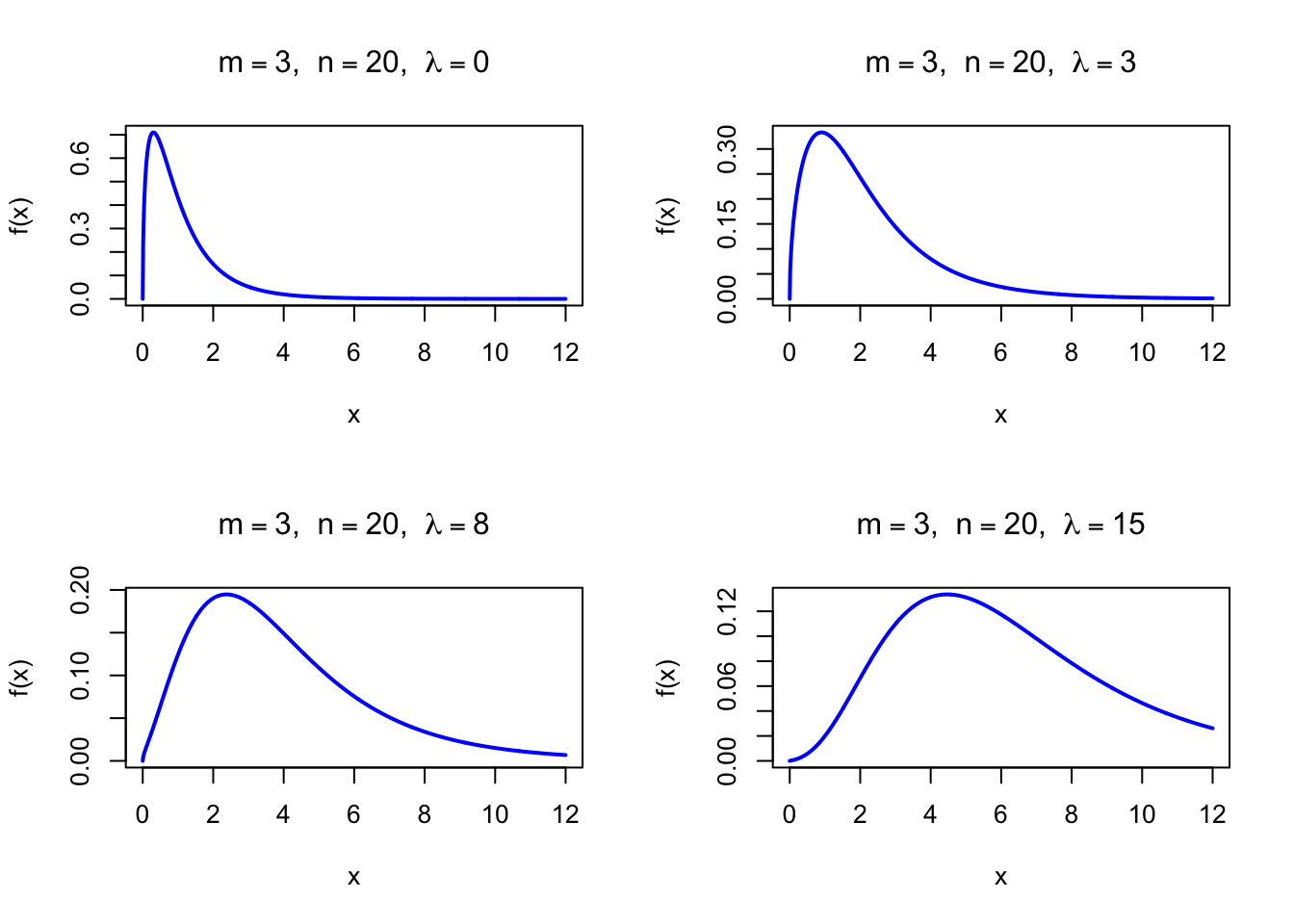
The figure below shows the Noncentral F Probability Density Function for \(m = 3\), \(n = 20\), and several values of \(\lambda\).
Code
par(mfrow =c(2, 2))x <-seq(0, 12, length =1000)plot(x, df(x, df1 =3, df2 =20, ncp =0), type ="l", lwd =2, col ="blue",xlab ="x", ylab ="f(x)", main =expression(paste(m ==3, ", ", n ==20, ", ", lambda ==0)))plot(x, df(x, df1 =3, df2 =20, ncp =3), type ="l", lwd =2, col ="blue",xlab ="x", ylab ="f(x)", main =expression(paste(m ==3, ", ", n ==20, ", ", lambda ==3)))plot(x, df(x, df1 =3, df2 =20, ncp =8), type ="l", lwd =2, col ="blue",xlab ="x", ylab ="f(x)", main =expression(paste(m ==3, ", ", n ==20, ", ", lambda ==8)))plot(x, df(x, df1 =3, df2 =20, ncp =15), type ="l", lwd =2, col ="blue",xlab ="x", ylab ="f(x)", main =expression(paste(m ==3, ", ", n ==20, ", ", lambda ==15)))par(mfrow =c(1, 1))
Figure 48.1: Noncentral F Probability Density Function (df1 = 3, df2 = 20) for various noncentrality values
48.2 Purpose
The Noncentral F distribution is the theoretical backbone of power analysis for F-tests, including ANOVA and regression. Its primary applications include:
ANOVA sample size planning: determining the number of observations per group needed to detect differences among \(k\) group means with desired power
Regression power analysis: computing the power to detect a given \(R^2\) or partial \(R^2\) in linear regression
Factorial experiment design: planning multi-factor experiments with adequate power for main effects and interactions
Model comparison: assessing whether a study has sufficient power to distinguish between nested regression models
Clinical trial design: justifying group sizes in multi-arm trials
Relation to the F-test. Under the null hypothesis (no group differences in ANOVA, or \(R^2 = 0\) in regression), the F statistic follows a central F distribution (\(\lambda = 0\)). Under the alternative hypothesis, it follows a Noncentral F distribution with noncentrality \(\lambda > 0\). Power is the probability that the observed F exceeds the critical value under the Noncentral F distribution.
48.3 Distribution Function
There is no elementary closed form for the CDF. It is computed numerically by pf(x, df1, df2, ncp) in R.
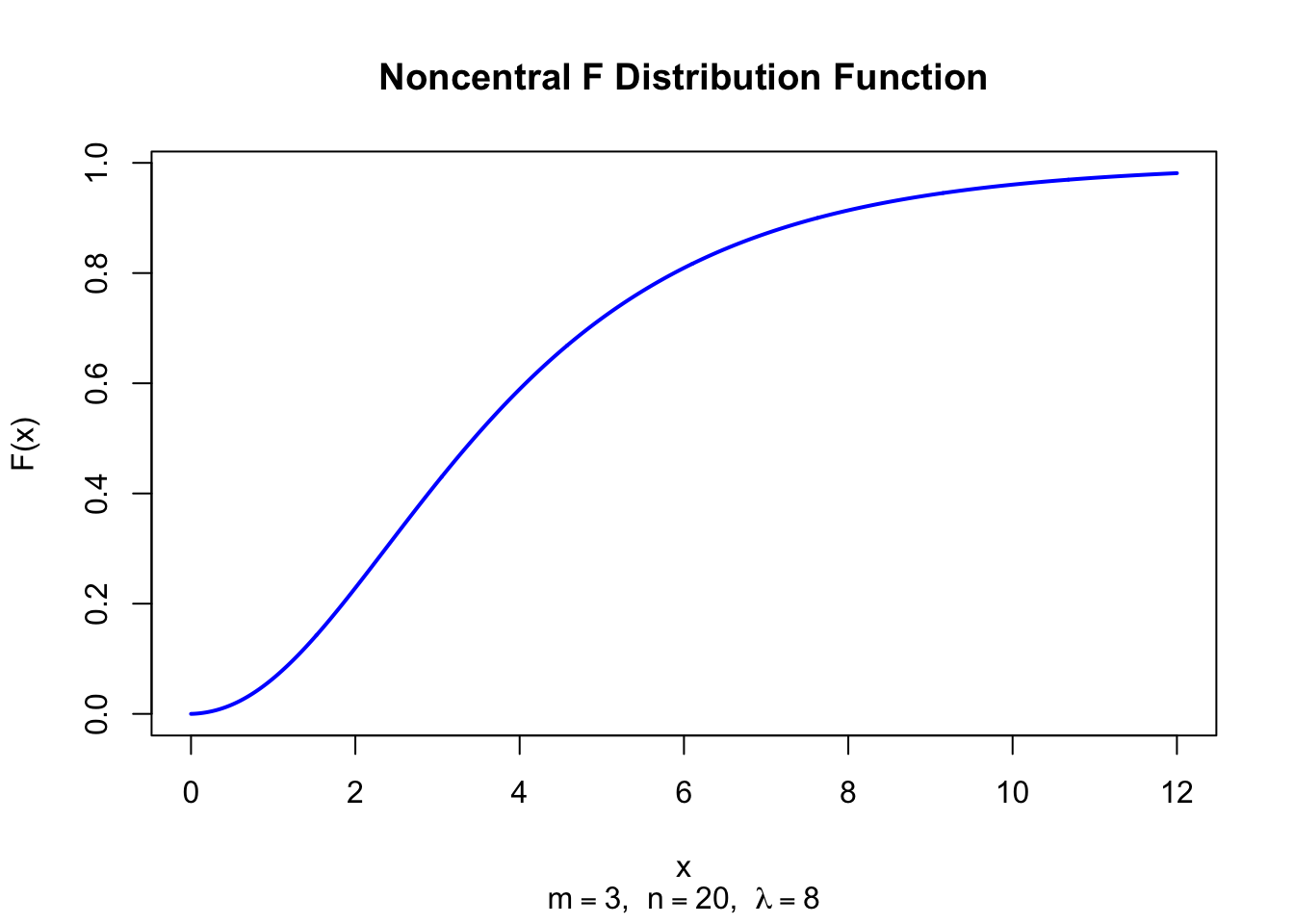
The figure below shows the Noncentral F Distribution Function for \(m = 3\), \(n = 20\), and \(\lambda = 8\).
Code
x <-seq(0, 12, length =1000)plot(x, pf(x, df1 =3, df2 =20, ncp =8), type ="l", lwd =2, col ="blue",xlab ="x", ylab ="F(x)", main ="Noncentral F Distribution Function",sub =expression(paste(m ==3, ", ", n ==20, ", ", lambda ==8)))
Figure 48.2: Noncentral F Distribution Function (df1 = 3, df2 = 20, lambda = 8)
48.4 Moment Generating Function
The moment generating function of the Noncentral F distribution does not have a simple closed form.
There is no closed-form expression for the median. It is computed numerically via qf(0.5, df1, df2, ncp) in R:
# Median for F(m = 3, n = 20, lambda = 8)qf(0.5, df1 =3, df2 =20, ncp =8)
[1] 3.443321
48.8 Mode
The mode of the Noncentral F distribution does not have a simple closed-form expression. It can be found numerically by maximizing the density function. For moderate to large noncentrality, the mode is approximately \((m + \lambda)(n - 2) / (m(n + 2))\) minus a correction term.
48.9 Coefficient of Skewness
The Noncentral F distribution is always right-skewed. The skewness depends on all three parameters (\(m\), \(n\), \(\lambda\)) and requires \(n > 6\) for existence. As the noncentrality \(\lambda\) increases, the skewness changes in a complex way. When \(\lambda = 0\), the skewness reduces to that of the central F distribution.
48.10 Coefficient of Kurtosis
The kurtosis of the Noncentral F distribution depends on \(m\), \(n\), and \(\lambda\), and requires \(n > 8\) for existence. The distribution is leptokurtic (kurtosis exceeds 3), with heavier tails than the Normal distribution. As \(n \to \infty\), the kurtosis decreases toward values closer to the Normal benchmark.
48.11 Parameter Estimation
Like the Noncentral t distribution, the Noncentral F distribution is not typically fitted to data via classical parameter estimation. Instead, the noncentrality parameter \(\lambda\) is determined from the experimental design:
One-way ANOVA (\(k\) groups, each with \(n\) observations): \(\lambda = k \cdot n \cdot f^2\), where \(f\) is Cohen’s \(f\) effect size defined as \(f = \sigma_{\text{between}} / \sigma_{\text{within}}\)
Regression (\(p\) predictors, \(N\) total observations): \(\lambda = \frac{N \cdot R^2}{1 - R^2}\) for the overall F-test of the model
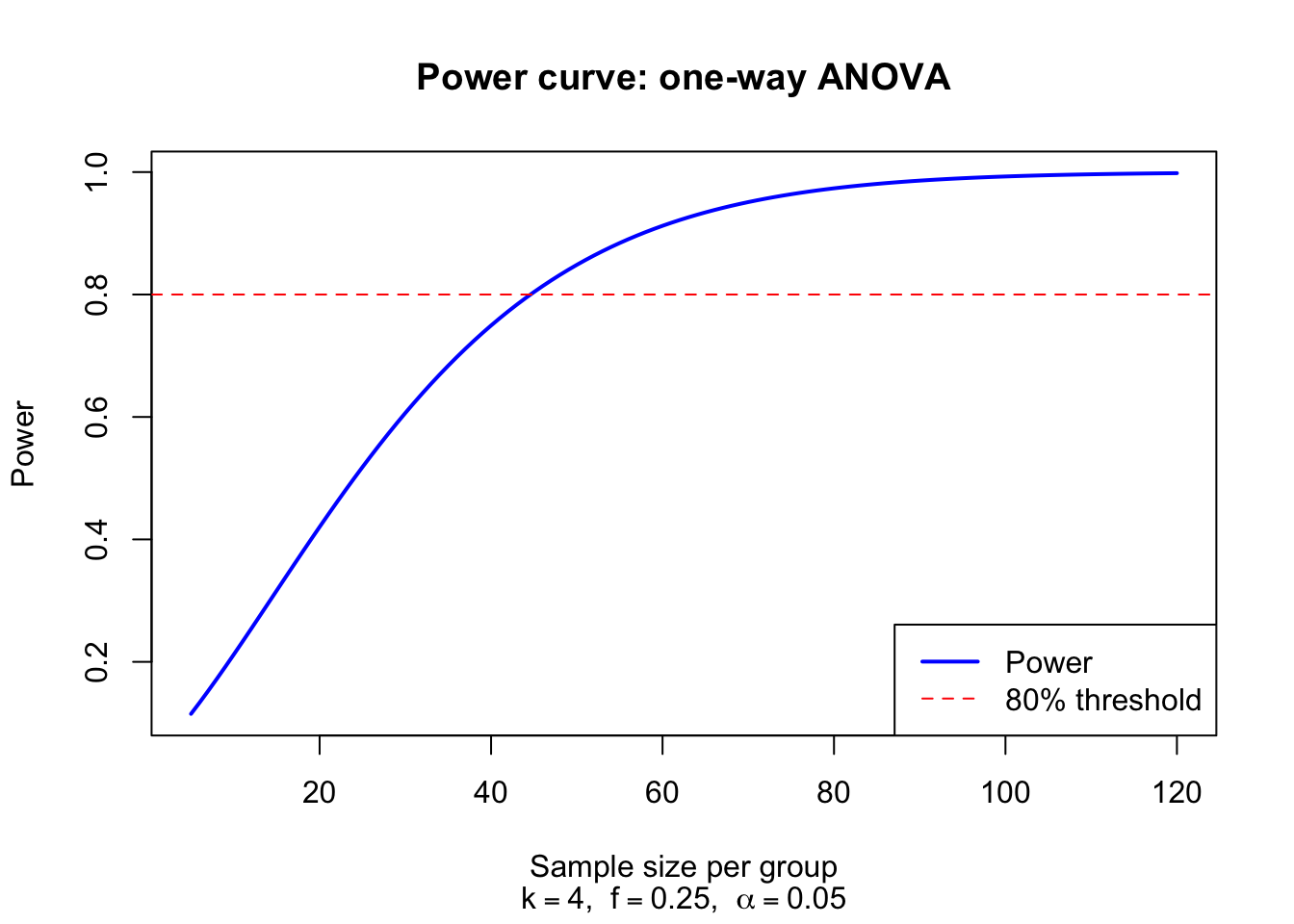
A psychologist plans a one-way ANOVA comparing \(k = 4\) treatment groups. Based on prior studies, a medium effect (\(f = 0.25\)) is expected. Using \(\alpha = 0.05\), how many subjects per group are needed for 80% power?
The noncentrality parameter for a one-way ANOVA is \(\lambda = k \cdot n \cdot f^2\), the numerator degrees of freedom are \(m = k - 1 = 3\), and the denominator degrees of freedom are \(n_{\text{denom}} = k(n - 1)\). We compute power for various group sizes:
k <-4# number of groupsf <-0.25# Cohen's f (medium effect)alpha <-0.05# significance level# Compute power for group sizes from 10 to 80n_per_group <-seq(10, 80, by =5)power <-numeric(length(n_per_group))for (i inseq_along(n_per_group)) { n_g <- n_per_group[i] df1 <- k -1 df2 <- k * (n_g -1) lambda <- k * n_g * f^2 f_crit <-qf(1- alpha, df1 = df1, df2 = df2) power[i] <-1-pf(f_crit, df1 = df1, df2 = df2, ncp = lambda)}result <-data.frame(n_per_group = n_per_group,N_total = k * n_per_group,lambda = k * n_per_group * f^2,power =round(power, 4))print(result)# Find minimum group size for 80% powern_required <- n_per_group[which(power >=0.80)[1]]cat("\nMinimum per-group sample size for 80% power:", n_required, "\n")cat("Total sample size:", k * n_required, "\n")
A second common application is regression power analysis. Suppose a researcher plans a regression with \(p = 5\) predictors and expects \(R^2 = 0.13\) (medium effect). How many observations are needed for 80% power?
p <-5# number of predictorsR2 <-0.13# expected R-squared (medium effect)alpha <-0.05N_vals <-seq(30, 200, by =5)power <-numeric(length(N_vals))for (i inseq_along(N_vals)) { N <- N_vals[i] df1 <- p df2 <- N - p -1 lambda <- N * R2 / (1- R2) f_crit <-qf(1- alpha, df1 = df1, df2 = df2) power[i] <-1-pf(f_crit, df1 = df1, df2 = df2, ncp = lambda)}result <-data.frame(N = N_vals, lambda =round(N_vals * R2 / (1- R2), 2),power =round(power, 4))print(result)# Find the exact minimum N by checking every feasible sample sizeN_search <-seq(p +2, 200, by =1)power_search <-numeric(length(N_search))for (i inseq_along(N_search)) { N <- N_search[i] df1 <- p df2 <- N - p -1 lambda <- N * R2 / (1- R2) f_crit <-qf(1- alpha, df1 = df1, df2 = df2) power_search[i] <-1-pf(f_crit, df1 = df1, df2 = df2, ncp = lambda)}N_required <- N_search[which(power_search >=0.80)[1]]cat("\nMinimum total sample size for 80% power:", N_required, "\n")
Random variates from the Noncentral F distribution can be generated directly from its construction. If \(U \sim \chi^2(m, \lambda)\) (Noncentral Chi-squared) and \(V \sim \chi^2(n)\) (central Chi-squared) are independent, then \(F = (U/m)/(V/n)\) follows \(\text{F}(m, n, \lambda)\).
In R, a Noncentral Chi-squared variate \(\chi^2(m, \lambda)\) can be generated as the sum of \(m - 1\) independent squared standard normal variates plus one squared \(\text{N}(\sqrt{\lambda}, 1)\) variate, or directly via rchisq(1, df = m, ncp = lambda).
set.seed(123)N <-1000m <-3n <-20lambda <-8# Construction methodu <-rchisq(N, df = m, ncp = lambda)v <-rchisq(N, df = n)x_construct <- (u / m) / (v / n)# Built-in functionx_rf <-rf(N, df1 = m, df2 = n, ncp = lambda)cat("Construction: mean =", round(mean(x_construct), 4)," var =", round(var(x_construct), 4), "\n")cat("rf(): mean =", round(mean(x_rf), 4)," var =", round(var(x_rf), 4), "\n")# Theoretical mean (requires n > 2)E_theory <- n * (m + lambda) / (m * (n -2))cat("Theoretical: mean =", round(E_theory, 4), "\n")
Construction: mean = 3.9133   var = 6.7732
rf():         mean = 3.862   var = 7.5764
Theoretical:  mean = 4.0741
Code
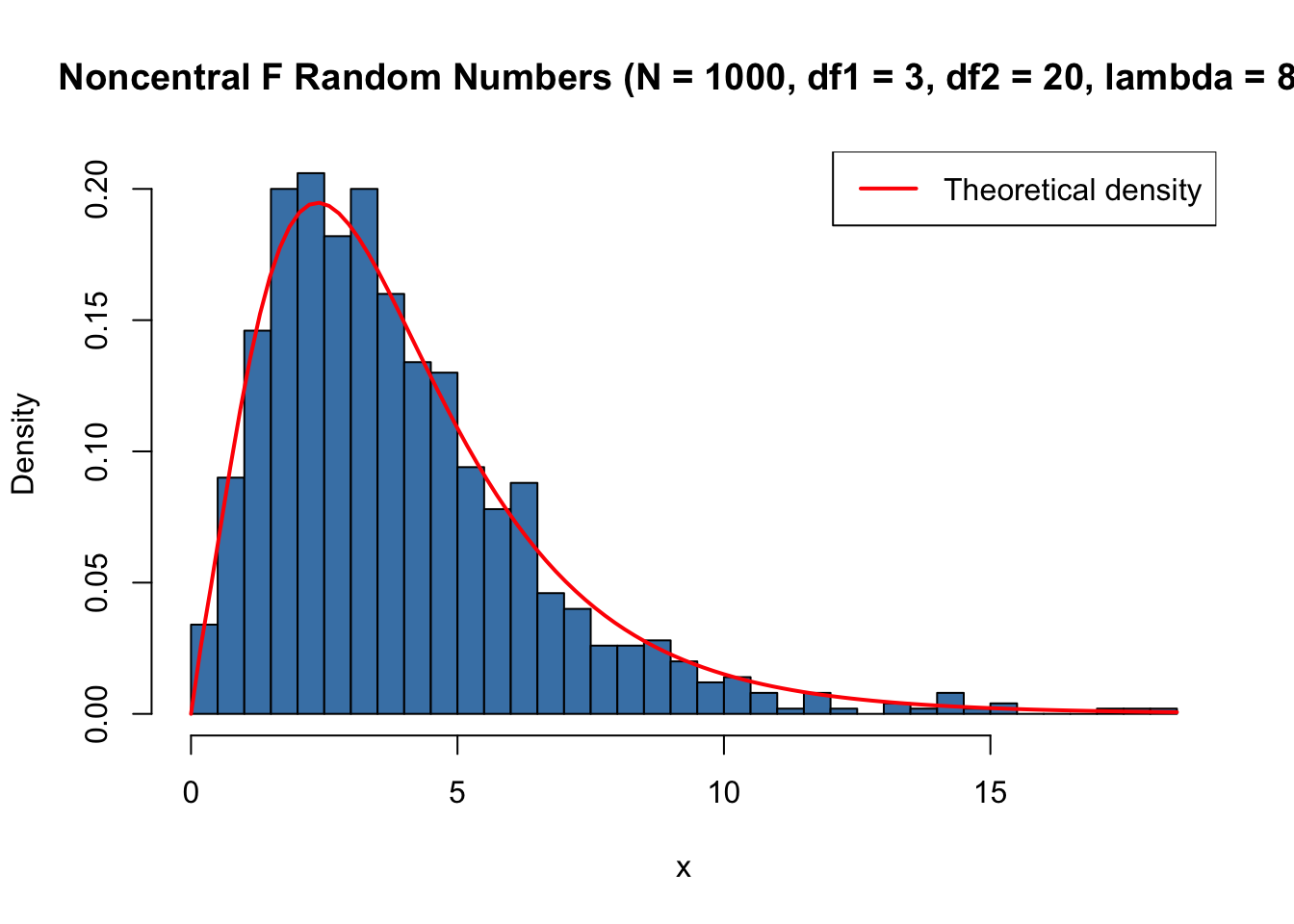
set.seed(123)x <-rf(1000, df1 =3, df2 =20, ncp =8)hist(x, breaks =40, col ="steelblue", freq =FALSE,xlab ="x", main ="Noncentral F Random Numbers (N = 1000, df1 = 3, df2 = 20, lambda = 8)")curve(df(x, df1 =3, df2 =20, ncp =8), add =TRUE, col ="red", lwd =2)legend("topright", legend ="Theoretical density", col ="red", lwd =2)
Figure 48.4: Histogram of simulated Noncentral F random numbers (N = 1000, df1 = 3, df2 = 20, lambda = 8)
48.15 Property 1: Noncentrality and Power for ANOVA
Under the null hypothesis of equal population means, the ANOVA F statistic follows a central \(\text{F}(k-1, N-k)\). Under the alternative, it follows \(\text{F}(k-1, N-k, \lambda)\) where
\[
\lambda = k \cdot n \cdot f^2 = \sum_{j=1}^{k} n_j \left(\frac{\mu_j - \bar{\mu}}{\sigma}\right)^2
\]
Power is the probability that the observed F exceeds the critical value:
\[
\text{Power} = \text{P}\!\left(F > F_{\alpha, m, n}\right) \quad \text{where } F \sim \text{F}(m, n, \lambda)
\]
As \(\lambda\) increases (larger effect or more observations per group), the Noncentral F density shifts to the right and more of its area falls beyond the critical value.
48.16 Property 2: Noncentrality Formulas for Regression
For testing the overall significance of a regression model with \(p\) predictors and \(N\) observations:
\[
\lambda = \frac{N R^2}{1 - R^2}
\]
For testing \(q\) additional predictors in a partial F-test:
These formulas directly connect effect sizes in regression to the noncentrality parameter.
48.17 Property 3: Convergence to Noncentral Chi-squared
As \(n \to \infty\), the scaled Noncentral F distribution converges to a scaled Noncentral Chi-squared:
\[
m \cdot \text{F}(m, n, \lambda) \xrightarrow{d} \chi^2(m, \lambda) \quad \text{as } n \to \infty
\]
This follows from \(V/n \xrightarrow{p} 1\) as \(n \to \infty\).
48.18 Property 4: Reciprocal Property
Unlike the central F distribution, the reciprocal of a Noncentral F variate does not follow a Noncentral F distribution. Therefore, the reciprocal symmetry of the central F (see Chapter 26) does not extend to the noncentral case.
48.19 Related Distributions 1: Central F as Special Case
The Fisher F distribution is the Noncentral F distribution with noncentrality parameter \(\lambda = 0\) (see Chapter 26):
\[
\text{F}(m, n, 0) = \text{F}(m, n)
\]
48.20 Related Distributions 2: Link with the Noncentral t Distribution
The square of a Noncentral t variate gives a Noncentral F variate with \(m = 1\) (see Chapter 47):
\[
T^2 \sim \text{F}(1, n, \delta^2) \quad \text{where } T \sim \text{t}(n, \delta)
\]
This means that power analysis for a two-sided t-test (with noncentrality \(\delta\)) is equivalent to power analysis for an F-test with \(m = 1\) and noncentrality \(\lambda = \delta^2\).
48.21 Related Distributions 3: Noncentral Chi-squared Connection
The Noncentral F distribution is constructed from the ratio of a Noncentral Chi-squared variate and an independent central Chi-squared variate (see Chapter 24). As \(n \to \infty\), the denominator converges to 1, and the Noncentral F converges to a scaled Noncentral Chi-squared.
48.22 Related Distributions 4: Beta Connection
The Noncentral F distribution is related to the Noncentral Beta distribution in the same way the central F is related to the Beta distribution (see Chapter 30). If \(X \sim \text{F}(m, n, \lambda)\), then \(Y = \frac{mX/n}{1 + mX/n}\) follows a Noncentral Beta distribution.